Showing posts with label ...hall of fame. Show all posts

Friday, August 1, 2014

Dick Williams (#87)

What a rookie season! After finishing no higher than 6th place for the previous 7 seasons (including two 9th and two 8th place finishes), the Red Sox gave Dick Williams his first big-league managing job in 1967, and he guided the team to their first World Series since 1946. Unfortunately, just as in ‘46, the Sox lost in 7 to the Cardinals.

Williams began his baseball career as an outfielder for the Brooklyn Dodgers. Signed in 1947, he played 4 seasons in the minors, then played for Brooklyn as a spare outfielder from 1951 to 1954.

Dick spent all of 1955 and part of 1956 in the minors. After only 7 games with the Dodgers in 1956, Williams was claimed off waivers by the Orioles, and became their regular center fielder for the remainder of the season.


In mid-June 1957, Williams was traded to the Indians, who then traded him back to the O’s a few days before the start of the ’58 season. After just one season back in Baltimore (this time as a swing man between 1B/3B/CF), he was shipped out to the Kansas City Athletics.

Williams played for the A’s in ’59 and ’60, starting about half the team’s games at 3rd base or 1st base. In 1961, Williams was traded on the 2nd day of the season to ... (anyone?) the Orioles! Now in his 3rd stint with the team, Dick shared the left field job with Russ Snyder, while also making the occasional start at 1st base. 1962 would be his last in Baltimore, and he was relegated to a utility role.

Williams wrapped up his playing career with 2 seasons in Boston, playing his final game on 10/1/64.

---

Dick immediately went into managing, piloting Boston’s AAA Toronto team to first-division finishes in ’65 and ’66. That earned him the Red Sox’ job in 1967, and what a year for the BoSox. Not only did they win the pennant, but Carl Yastrzemski won the Triple Crown, and Jim Lonborg led the AL in wins and strikeouts while winning the Cy Young award.

Williams managed the Red Sox until his firing with a week remaining in 1969. He moved on to Oakland for 1971-73, guiding the team to 3 division titles and 2 World Championships in his 3 seasons. This was all done with players that were famous for not liking each other (or not liking Williams, I don't remember which).

Dick had less success with the Angels (1974-76) and the Expos (1977-81), then moved on to the Padres from 1982-85, including winning the NL pennant in 1984. His final manager’s job was with the Mariners from 1986-88. He later worked for the Yankees as a consultant.

In 21 seasons as a manager, Williams compiled a 1571-1451 record, with 4 pennants and 2 World Series Championships. He was inducted into the Hall of Fame in 2008.

Williams passed away in July 2011 at age 82.

Sunday, June 15, 2014

Don Sutton (#103)

Here is future Hall-of-Fame pitcher Don Sutton, about to enter his 3rd season. His 1966 rookie season was also Sandy Koufax’ final season.

Sutton was signed by the Dodgers in 1964, and pitched only 1 season in the minors. He compiled a 23-7 combined record, pitching in A and AA ball in 1965. Don made his big-league debut in April 1966 as the #4 starter behind Koufax, Don Drysdale, and Claude Osteen. Sutton posted a record of 11-11 with 209 strikeouts and a 2.99 ERA.

With Koufax’ retirement after 1966, everyone moved up a notch in the starting rotation. Don posted 2 consecutive 11-15 seasons, then bounced back in 1969 with 17 wins and 217 strikeouts.


Sutton was one of the Dodgers’ top starting pitchers through the 1980 season, partnering first with Drysdale, Osteen and Bill Singer, then later on with Al Downing, Andy Messersmith, and Tommy John. He led the league with 9 shutouts in 1972, and with a 2.20 ERA in 1980. Don made the all-star team in ‘72, ’73, ’75, and ’77, and finished in the top 5 Cy Young voting every season from 1972 to 1975. Sutton also pitched in the NLCS and World Series in ’74, ’77, and ’78.

Don became a free agent after the 1980 season, and signed with the Astros. After 1 ½ seasons in Houston he was traded to Milwaukee in August ’82 for outfielder Kevin Bass and two others, as the Brewers geared-up for their first post-season.

Sutton went 4-1 in 7 starts for the rest of the season, and was 1-1 in 3 post-season games. He pitched for 2 more seasons in Milwaukee, then was traded to the Athletics after the 1984 season.

Don bounced around for the next 3 seasons from the Athletics to the Angels, before finishing his career in 1988 with the Dodgers. He was a starting pitcher right up to the end, finally getting his release on August 10, 1988. Sutton pitched for 23 seasons, amassing 324 wins and 3574 strikeouts.

In 1998, Sutton was inducted into the Hall of Fame, and also had his #20 retired by the Dodgers.

Sutton has been broadcasting baseball games since 1989, mostly for the Braves.

Tuesday, November 26, 2013

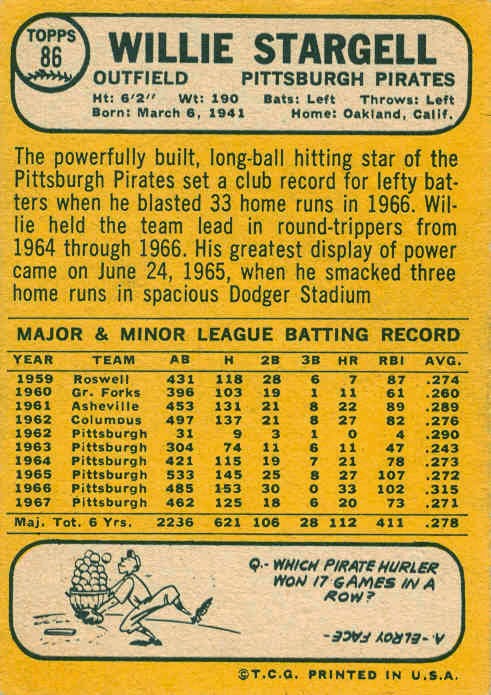
Willie Stargell (#86)

Here is Pirates' OF-1B Willie Stargell, who came to be known as "Pops" later in his career.

Stargell was signed by the Pirates late in 1958. He played in the minors for 4 seasons (1959-62), and made his big-league debut with the Pirates in September 1962.

Willie stuck with the Pirates at the start of the 1963 season. He shared the left field job with veterans Jerry Lynch and Bob Skinner, and also started a dozen or so games at first base and right field, when regulars Donn Clendenon and Roberto Clemente got some time off.

Stargell started 105 games in his 2nd season, splitting them fairly evenly between 1st base and left field. He made his first of 7 all-star games, and began a streak of 13 years with 20 or more home runs.


The next few seasons were not “Stargell-like”, but he put up numbers that most players would strive for. Willie was the Pirates’ regular left fielder from 1965 to 1974, except for playing mostly 1st base in 1972.

In 1971, he collected a career-high 125 RBI, and led the NL with 48 home runs. The Pirates also won the World Series that year, although it was still “Clemente’s team”.

In 1973 Willie led the league in doubles (43), homers (44), and RBI (119). He was the MVP runner-up in both ’71 and ’73. After years as the left fielder, Stargell switched to 1st base beginning in 1975, and never returned to the outfield.

His stats drifted downward from 1974 through 1977, but he had another monster season in 1979, clubbing 32 homers and leading the Pirates to their 2nd World Series championship of the decade. He also won the NL MVP award in 1979. Willie played in the post-season in ’70, ’71, ’72, ’74, ’75, but was at his best in the 1979 post-season, hitting 2 homers in the NLCS and 3 in the World Series, while batting over .400 for the post-season.

That would be it for Willie’s glory days, as he became a part-time player from 1980-1982. He retired after the 1982 season, with 475 home runs and 1540 RBI in 21 seasons.

He later coached for the Braves, then worked in the Pirates’ front office. Willie was inducted into the Hall of Fame in 1988.

Stargell passed away at age 61 on April 9, 2001, which was also opening day for PNC Park, the Pirates new ballpark. A statue of Stargell was unveiled that same day at the park.

Sunday, October 27, 2013

Phil Niekro (#257)

Phil Niekro was signed by the Milwaukee Braves in 1958. Phil played 4 seasons in the minors (1959-62), as a reliever, then missed the 1963 season while in military service. He made the Braves’ team to begin the 1964 season, but after 10 relief appearances, he was sent down to triple-A Denver in mid-May for the remainder of the season. During that time, he became primarily a starting pitcher.

Niekro returned to the Braves for all of 1965, although he was back in the bullpen for all but 1 of his 41 games. In 1966, Phil appeared in 28 games (all in relief), but spent all of June and July in the minors.


"Knucksie" started the 1967 season in the bullpen, but joined the starting rotation on June 13th, where he would remain for the next 16 seasons. Niekro led the NL with a 1.87 ERA in 1967, and would win in double figures for the next 20 seasons (except the strike-shortened 1981 season). He led the NL in strikeouts in 1977 (262), and wins in 1974 (20) and 1979 (21). He also won 23 games in 1969.

After compiling a record of 11-10 in 201 innings in 1983, the Braves released Niekro. He was quickly signed by the Yankees, winning 16 games in each of his 2 seasons with New York. Phil was released by the Yankees during spring training in 1986, but played for the Indians for the next year and a half. Niekro was traded to the Blue Jays in August 1987, then was released at month’s end. He re-signed with the Braves for the final week of the season, then retired.

Phil pitched in 864 games during his 24-year career. His 318 career wins are the most by a knuckleball pitcher. (As kids, he and his brother Joe learned to throw a knuckleball pitch from their father.)

Niekro was inducted to the Hall of Fame in 1997. His #35 (which he wore for his entire career) was retired by the Braves in 1984, 3 seasons before his retirement.

Among his other post-retirement activities, he coached a women’s professional baseball team.

Thursday, October 17, 2013

Bob Gibson (#100)

Last week, I was surprised to realize that I hadn’t featured Willie McCovey on any of my blogs so far. This was corrected immediately with a post to the 1967 blog. Later, I took a mental cross-country trip (NYM-Phil-Pitt-ChiC-StL-Atl-Cinn-Hou-SF-LA) and a 2nd lap (Bos-NYY-Balt-Wash-Clev-Det-ChiW-Minn-KC/Oak-Cal) to see if I could think of any superstars that I missed on my blogs. 

This exercise netted Bob Gibson, Hank Aaron, Harmon Killebrew, and Johnny Bench, and some lesser stars like Jim Hunter, Tony Oliva, Phil Niekro, Billy Williams, Norm Cash, Willie Horton, Boog Powell, Bill Mazeroski, and Willie Stargell. So, I’ve got my work cut out for me over the next few weeks… 


First up is Bob Gibson, the lead dog during 1968’s “The Year of the Pitcher”. Gibby followed up a 3-complete-game (and a 1.00 ERA) 1967 World Series performance with a 1968 season where he led the NL with 13 shutouts, 268 K's, and a 1.12 ERA. (That’s ONE point ONE TWO!)

He also compiled a 22-9 record, and won both the Cy Young and MVP awards. Gibson pitched another 3 complete games in the World Series, but unlike the previous season, he was 2-1 in those games. Bob's post-season ERA was a miniscule 1.67. Oh… he also set a record by striking out 17 Tigers in game #1.
 

Gibson was signed by the Cardinals in 1957, and made his major-league debut in April 1959, although he spent a good deal of time in the minors during both 1959 and 1960. He also played basketball for the Harlem Globetrotters during these early years.

Bob made the majors to stay in 1961, and spent his entire career (1959-75) with the Cardinals. He had double-digit wins every season from 1961 to 1974, and won 20 or more games in ’65, ’66, ’68, ’69, and ’70 (missing 2 months with a broken leg in 1967). His 23 wins led the NL in 1970.

Hoot’s “ace of staff” days were from 1963 to 1972, although Curt Simmons managed to keep up with him in ’63 and ’64. Besides his World Series performances in ’67 and ’68, Bob also won 2 of his 3 starts in the 1964 Series against the Yankees.

Gibson ended his career with a down year in 1975, when he was 3-10 in only 109 innings.

He was a 1st-ballot Hall of Famer in 1981.

After his playing career, Bob was the pitching coach for the Mets and the Braves in the early 1980s, while former teammate Joe Torre managed those teams.


This is my original card from 1968, and is well-scuffed from all the "playing time" it got. This is the last of the 1968 "hero cards" that I listed in the first such post. 

Wednesday, July 31, 2013

Orlando Cepeda (#200)

Card #200 in the 1968 set is Orlando Cepeda. Good choice! Cepeda was the 1967 NL MVP, led the league with 111 RBI, bashed 25 homers, and bat .325 during the season (although only .103 in the World Series).

Orlando was signed by the New York Giants in 1955. After 3 seasons in the minors, Cepeda began the 1958 season with San Francisco, and started 147 games at first base, en route to winning the Rookie of the Year award (only the 2nd player to win unanimously).

In late-July 1959, the Giants called up rookie Willie McCovey, moving Cepeda to left field for the rest of the season. Cepeda played most of 1960 in left field, but when McCovey spent the 2nd half of the season in the minors and on the Giants' bench, Orlando reclaimed the 1st base job.

He split the 1961 season between 1B and LF, and led the NL in home rums (46) and RBI (142). Cepeda returned to his old 1st base job for the 1962-64 seasons, but missed most of the 1965 season with a knee injury.


Orlando was traded to the Giants in May 1966 for pitcher Ray Sadecki. He spent 3 seasons in St. Louis (including his MVP season in '67 and World Series appearances in '67 and '68).

During spring training 1969, he was traded to the Braves for catcher Joe Torre. He had another big power season in 1970 (34, 111), then was traded to the Athletics in July 1972 for pitcher Denny McLain.

Cepeda only played 3 games with the A's when a knee injury ended his season. Released after the season, he hooked on with the Red Sox when the AL instituted the DH before the 1973 season. He DH'ed in 142 games, but never played the field or pinch-hit that season.

He was released after the 1973 season, and spent most of 1974 playing in Mexico, until the Royals signed him for the final two months of the season.

Cepeda was elected to the Hall of Fame in 1999 by the Veterans Committee.

Sunday, July 14, 2013

Frank Robinson (#500)

Continuing the mini-series on "cards ending with "00", here is #500 Frank Robinson.

I have to take issue with Topps' selection of Robinson. Wasn't #500 the ultimate "hero number" back in the day? ( In 1969, Mickey Mantle's final card was #500.)

Prior to the 1966 season, Robinson came over to the Orioles in a big trade with Cincinnati. In his first season with the O's, he won the Triple Crown, the AL MVP, and the World Series MVP.

Still, that was 2 years ago, and since then Carl Yastrzemski won the 1967 Triple Crown and played in the World Series, and several members of the world champion Cardinals (Bob Gibson, Orlando Cepeda) had monster years. Was Topps making amends for "only" giving Robby #100 in the 1967 set?


Robinson was signed by the Reds in 1953, and after 3 seasons in the minors, he spent 10 full seasons as a regular with Cincinnati.  He was the Rookie of the Year in 1956, and the NL MVP in 1961.

He played in 4 World Series during his six seasons with Baltimore. In 1972 he began bouncing around to several teams as his playing career wound down: Dodgers ('72), Angels ('73, '74), and Indians ('74-'76).

He also managed the Indians (1975-77), Giants (1981-84), Orioles (1988-91), and the Expos/Nationals (2002-06).  In 16 seasons as manager, his teams finished as high as 2nd place twice.


Saturday, January 12, 2013

Rod Carew (#80)

I've already posted 1st baseman Lee May's all-rookie card, so let's skip ahead to 2nd base.

Rod Carew checks in as the 2nd baseman on Topps' 1967 All-Rookie team (which makes sense, since he was the AL Rookie of the Year). This was my first Carew card, as to this day Rod's 1967 rookie card is one of 4 cards I need to complete that set.

Carew was born in the Panama Canal Zone in 1945, but grew up in New York City. He was signed by the Twins in 1964, and played a half-season in rookie ball in '64, then 2 seasons in class-A ball before making his major-league debut at the start of the 1967 season. (Carew hit .303 in his 1st season in class A. I wonder why the Twins didn't promote him to double A for 1966. Maybe it was his 28 errors at 2nd base?)


Rod assumed the starting 2nd base job on opening day 1967, and started 131 games there (missing 17 consecutive games in mid-August). Carew was a slam-dunk for Rookie of the Year, getting 19 of the possible 20 votes (Red Sox' center fielder Reggie Smith received 1 vote). He also made his first of 18 consecutive all-star teams.

Carew played his first 12 seasons with the Twins. During that time, he led the AL in batting 7 times, and hit over .330 in 2 other seasons.

He switched to 1st base in 1976, and continued his torrid hitting. Rod was the AL MVP in 1977, while leading the league in runs, hits, triples, batting average, on-base percentage, and OPS. He also collected 100 walks that season.

In February 1979, Carew was traded to the Angels for pitchers Paul Hartzell and Brad Havens, catcher Dave Engle, and outfielder Ken Landreaux. His league-leading days were over, although he hit over .300 in his first 5 seasons in California, including .339 in 1983.

Injuries limited him to 93 games in 1984, although he hit .295 that season. Carew's final season was 1985, the only year he didn't make the all-star team.

Rod appeared in the post-season 4 times: '69 and '70 with the Twins, and '79 and '82 with the Angels.

He was inducted into the Hall of Fame in 1991, with 90% of the vote.

Monday, November 26, 2012

Tom Seaver (#45)

Tom Seaver was the right-handed pitcher on Topps’ all-rookie team in 1967.

Seaver was drafted by the Dodgers in June 1965 but did not sign. He was then drafted by the Braves the following January, but the pick was voided by the commissioner on a technicality involving his college playing status. The Mets won a lottery (which also included the Phillies and Indians) and signed Seaver in April 1966.


After 1 season in the minors, “Tom Terrific” debuted with the Mets in April 1967, starting the 2nd game of the season, and going on to start 34 games and pitch 251 innings (leading the team in both categories). With 16 wins, he was the only Mets’ pitcher with double-digit wins, and was named the NL Rookie of the Year.

Seaver spearheaded the Mets' rise to respectability, after spending their first 7 seasons as the league's doormat. He was an all-star in 11 of his first 12 seasons (only missing in 1974). He also won the Cy Young award in ’69, ’73, and ’75. Tom was a 5-time 20-game winner, and led the NL in wins in 1969 and 1975. Seaver led the NL in strikeouts 5 times and ERA 3 times. All of the above stats were as Met.

During the 1977 season, he was traded to the Reds and continued winning through the 1981 season. After an off-year in 1982, he returned to the Mets for 1983 (another sub-par season), then had 2 good years for the White Sox (1984-85) before wrapping up his career in 1986 with the ChiSox and BoSox.

Seaver pitched in the post-season 3 times: ’69 and ’73 with the Mets, and 1979 with the Reds.

Thursday, January 21, 2010

Don Drysdale (#145)

Don Drysdale was one of the top pitchers of the 1960s. (If I was forming a team of 1960s' stars, my pitching staff (10-man, of course, after all this is the 1960s!) would be:
Sandy Koufax
Bob Gibson
Juan Marichal
Don Drysdale
Whitey Ford
Fergie Jenkins
Jim Kaat
Sam McDowell
Luis Tiant
Tom Seaver

Relievers? We don't need no relievers!

Where was I? Oh yes...

Drysdale was signed by the Brooklyn Dodgers in 1954, and played 2 seasons with their minor-league teams, including 1955 with the Montreal Royals. One of Don's teammates there was Tommy Lasorda. [Drysdale was with Montreal one year after Roberto Clemente played there. I wonder how many don't know that Clemente was signed by the Dodgers, then lost to the Pirates after one season, in the rule 5 draft. OUCH!]


Drysdale made his major-league debut in April 1956, and played his entire 14-year career with the Dodgers, retiring after the 1969 season. He won 25 games and the Cy Young Award in 1962, and won 23 games in 1965. He also led the league in strikeouts 3 times between 1959 and 1962. In 1968, he set a record by pitching 58 consecutive scoreless innings.

He even found the time to give baseball pointers to the youth of America:

Wednesday, January 13, 2010

Walter Alston (#472)

Walter Alston was the Dodgers' manager from 1954 to 1976. This was a total of 23 seasons, all on 1-year contracts. He was followed by Tommy Lasorda from 1977 to midway through the 1996 season (another 19 1/2 years). So, for 42 1/2 years, the Dodgers only had 2 managers. Compare that with the revolving door of the past 13 years, where 5 different managers have led the Dodgers.

In Alston's first 13 seasons at the helm, the Dodgers finished in first place 6 times, including 4 World Series championships, and finished in second place 3 times.


After a 3-year slump from 1967-1969 (which included two 8th-place finishes), the Dodgers finished in either first or second place in 6 of Walt's last 7 years.

Alston was replaced by Tommy Lasorda for the final 4 games of 1976, but it must have been for health reasons, because the Dodgers were in 2nd place at the time.

Tuesday, December 1, 2009

Ernie Banks (#355)

Here we have Chicago Cubs superstar Ernie Banks. "Mr. Cub" never played minor league baseball, but he did play for the Kansas City Monarchs of the Negro American League from 1950 to 1953.

Banks is one of a handful of former Negro League players still playing major league baseball into the late 1960s. I guess it's common knowledge that Willie Mays and Hank Aaron were Negro League veterans, but I recently learned that Yankees catcher Elston Howard was Banks' teammate with the Monarchs. (I also discovered that early 1970s Detroit Tigers infielder Ike Brown played in the Negro Leagues. I mistakenly assumed that anyone not making the major leagues until the 1970s would have been too young to play Negro League baseball.)

Banks was signed by the Cubs on September 8, 1953, and made his major-league debut at shortstop on September 17th, playing 10 games that first season.

From 1954 to 1969, Banks was in the lineup almost every day, playing 150 or more games for 12 of those 16 seasons. Between 1954 and 1960, he led the league in games played 6 times. Banks was originally the Cubs regular shortstop, but in 1962 he moved over to first base.


Beginning with the 1970 season, the 39-year-old Banks cut back his workload, sharing the first base job with Jim Hickman. In 1971, Joe Pepitone took over the first base chores, while Banks only played 20 games at 1B. He appeared in 52 other games as a pinch-hitter.

Ernie was released by the Cubs after the 1971 season. He had played his entire 19-year major-league career with the Cubs, and retired with 512 homeruns. His 277 homeruns as a shortstop was the record until Cal Ripken came along.

Monday, October 26, 2009

Jim Palmer (#575)

Jim Palmer was a key part of the Orioles pitching staff for almost 2 decades.


The early years:

His major-league career began in 1965. Since the rotation was already capably manned by Milt Pappas, Steve Barber, Dave McNally, and Wally Bunker, Palmer found himself as the #3 man in the bullpen behind Stu Miller and Dick Hall. He did manage to make 6 starts to go along with his 21 relief appearances.

Palmer's potential enabled the Orioles to trade Pappas to the Reds for Frank Robinson prior to the 1966 season. In his 2nd year, Palmer joined the starting rotation and made 30 appearances (all starts). He was the #2 starter in innings (behind McNally), with Bunker and Barber completing the rotation. The top-notch pitching, along with Frank Robinson's triple crown season, led the Orioles to a World Series championship.

In 1967, the wheels fell off the entire starting rotation, with Palmer affected the most. Because of a sore arm, he made only 9 starts for Baltimore in 1967. He was sent down and only played 34 innings combined in A and AAA ball. The Orioles dropped to 6th, as McNally and Bunker were also having problems.

In 1968, he wasn't on the Orioles at all, and only managed to pitch 37 innings combined for 3 Orioles farm teams. (Back then, the Orioles were my "A.L. team", and Palmer was one of my favorite players. I remember thinking at the time that Palmer was done.) Meanwhile, the Orioles rebounded to 2nd place, thanks to McNally's comeback season of 22 wins.

In 1969, Palmer was back, with 16 wins. Mike Cuellar was acquired from the Astros (for Cury Blefary - what a steal!), and posted 23 wins. McNally won 20 games, and the Orioles finished in 1st place, meeting the Mets in the World Series.

In 1970, Palmer began a string of winning 20 or more games 7 times in 8 years. The rest is well-known history.

Sunday, October 25, 2009

Final Card: Eddie Mathews

Eddie Mathews (#58) began playing pro baseball in 1949 at High Point-Thomasville, in the class-D North Carolina State League. He also played in Atlanta and Milwaukee when they were Braves' minor league teams.

His major-league debut was in 1952 with the Boston Braves. After 15 years as a fixture with the Braves, Mathews was traded to the Astros, where he joined the 500 homerun club in 1967. In August 1967, he was dealt to Detroit (for pitcher Fred Gladding), where he finished his career by getting a World Series ring with the 1968 Tigers. What better way to go out!


Tuesday, October 6, 2009

Mickey Mantle (#280)

Another all-time great centerfielder!

Although this is not Mantle's last card, 1968 was his last season. (He retired during spring training in 1969. Topps' 1969 Mantle card includes a retirement note.)

The back of this card shows that the Mick has been slipping since 1965, although through 1967, his career batting average was still over .300 (he would finish 1968 with a .298 career batting average).

Due to his limited mobility, Mantle played first base during his last 2 seasons, switching positions with Joe Pepitone.


Willie Mays (#50)

Topps got a little lazy when it came to Mays' cards. This is the same photo that was used on the 1965 card. (The 1966 Mays photo was also used in 1969.)

It looks like age is catching up to Willie. A quick check on his stats shows that 1967 was an off year for Mays. 1966 was a good year for him, but it was a step down from his previous seasons. Willie went on to play 5 more seasons, finishing in 1973 with the NL champion Mets. He retired with 660 home runs (2nd place at the time).


Notice the typo in 1963: ("Sna Fran").