Showing posts with label ..expansion Seattle Pilots. Show all posts

Friday, May 14, 2021

Mike Hegan (#402)

This is Mike Hegan’s first solo card. He previously appeared on a late-1967 Yankees Rookies card. 
 
Hegan was the son of long-time Indians' catcher and Yankees' coach Jim Hegan. Mike was signed by the Yankees in 1961 and made his major-league debut in September 1964.
He was back in the minors for all of 1965 and most of 1966, but made the Yankees' squad in 1967. That was the year Mickey Mantle moved from center field to 1st base, so Hegan got into 68 games, mostly as a late-inning replacement for Mantle. 
 
Hegan spent all of 1968 back in triple-A (his job as Mantle’s caddie taken by the newly-acquired Andy Kosco). In mid-June he was sold to the Seattle Pilots' organization, but as they did not have any teams in place yet, he remained with the Yankees’ Syracuse team through the end of the season. 
 
He played for the Pilots in 1969, and was their primary right fielder. He also made the All-Star team that year (so the often-repeated statement that Don Mincher was the Pilots’ only All-Star is not correct). 
 
Hegan played for the Brewers until mid-June 1971, and 3 years to the day he was acquired, the team traded him to the Athletics. Mike was sold back to the Yankees in late-1974, and (appearing to re-trace his career steps) he was acquired by the Brewers in early-1975, where he remained as a bench player until he was released in July 1977. 
 
After his playing career, he was a commentator for the Brewers for 12 seasons, and then for the Indians for another 23 seasons. 
 
Hegan passed away in 2013 at age 71.

Saturday, April 25, 2020

Larry Haney (#42)

Check out the infamous 1968 and 1969 Larry Haney cards.
He’s right-handed! He’s left-handed! He’s ambidextrous!


Larry Haney was signed by the Orioles in 1961, and after 5 ½ seasons in the minors was promoted to Baltimore in late-July 1966. He played 20 games that season.

Over the first 100 games, The Orioles started Andy Etchebarren 86 times, Vic Roznovsky 12 times, and Camilo Carreon 2 times. (Charlie Lau was also on the roster, but by then he was only pinch-hitting.)

Haney was called up in time for game #101, and over the next 2 weeks he started 8 games, giving Etch some much-needed rest. Larry started 15 times over the final 60 games (with Roznovsky making 13 starts). Etchebarren started 32 games, including a 19-game stretch that included both ends of two doubleheaders. (What was the manager thinking?)

Anyway, in 1967 Haney took over as the #2 backstop, starting 45 games.

Haney missed the first half of 1968, with only 3 of his games coming before June 28th. He wasn't in the minors, so was either injured or nailed to the bench. Elrod Hendricks joined the team at the start of 1968, and with "Clank" Blefary also catching 38 games, Haney was relegated to 4th-string catcher.

After the season, Larry was selected by the Seattle Pilots in the expansion draft. He started 15 of the first 50 games for the Pilots, but by mid-June was traded to the Athletics for 2nd baseman John Donaldson. He finished out the 1969 season with Oakland, but spent much of 1970-73 in the minors, mostly in the A's organization but also on the Padres' farm in 1972.

Haney returned to the majors with the Athletics from 1974-76. In '74, he shared the catching load with Ray Fosse and Gene Tenace. After playing sparsely in 1975, he and Tenace split the catching assignments evenly in 1976 (with Haney catching whenever Tenace played 1st base).

After the 1976 season, Haney was acquired by the Brewers. He started a third of the games in 1977 (backing up Charlie Moore), He was the team’s bullpen coach in 1978 but was activated for the final 2 weeks of the season.

Haney was a coach for the Brewers from 1978 to 1991, and continued to work for the team until 2006.

His son Chris was a pitcher for the Royals and others from 1991-2002.

Monday, March 16, 2020

John Donaldson (#244)

John Donaldson played 6 seasons from 1966-1970, and in 1974, all for the Athletics except for playing the 2nd half of 1969 with the Seattle Pilots.

Donaldson was signed by the Twins before the 1963 season, and drafted by the Kansas City Athletics after his first season. He played in the Athletics’ farm system for the next 3 seasons, initially as a shortstop until making the switch to 2nd base in 1966.

John made his major-league debut in late-August 1966, playing 15 games over the final weeks of the season.


After starting the 1967 season in AAA, he joined the Athletics in early-June and started 100 of the final 110 games at 2nd base, pushing incumbent Dick Green over to a 3rd base rotation with Danny Cater and Sal Bando.

In 1968 he started 81 of the first 103 games at 2B, then was replaced by Green and only made 9 more starts for the rest of the season, including three at 3rd base.

Donaldson found a seat on the bench in 1969, his only start coming in the first game of a May 30th doubleheader. On June 14th he was traded to the Seattle Pilots for backup catcher Larry Haney. He returned to regular playing time with the hapless Pilots, starting 91 of the final 107 games.

In mid-May 1970, the Brewers traded him back to the Athletics for shortstop Roberto Pena. John returned to the backup role he had from mid-‘68 to mid-‘69.

Donaldson didn’t make the team in 1971, and spent the next 3 years in the minors – bouncing to the Tigers, Orioles, and Padres, but never playing for any of them.

He was released by the Padres in April 1974 and signed with the Athletics. He spent most of his final season in the minors, but did play 9 games for the Athletics in April and May, and one in October.

Saturday, August 31, 2019

Steve Whitaker (#383)

Here is outfielder Steve Whitaker, in his last season as a Yankee.

Whitaker was one of a long line of Yankees' outfielders (along with Roger Repoz, Bill Robinson, Roy White, Bobby Murcer, and Jerry Kenney) who were touted as, if not the next Mickey Mantle, then the next Roger Maris or surely the next Tom Tresh. (Only White and Murcer panned out for the Yankees. )


Whitaker was signed by the Yankees in 1962, and played in the minors from 1962-65. He bashed 27 homers in ’64 and 24 in ’65. He also hit 20 homers in 1966 before his August call-up to the Yankees.

In 1967 he started 108 games in the outfield (mostly in right field, replacing the traded Maris), but only hit 11 home runs while batting at a .243 clip.

Steve split the 1968 season between the Yankees and triple-A, then was selected by the Royals in the expansion draft.

During spring training in 1969, he was traded to the Seattle Pilots for disgruntled rookie Lou Piniella (who went on to win the Rookie of the Year award). Whitaker didn’t fare as well as Piniella. He couldn’t find regular work with the expansion team, and was used mostly as a pinch-hitter, while also spending all of August back in triple-A.

After the 1969 season he and outfielder Dick Simpson were traded to the Giants for pitcher Bob Bolin. He only played 16 games for the Giants (the last on May 9th) and played the remainder of 1970 for the Giants’ AAA team.

Whitaker played for the Padres’ AAA team in Hawaii in '71 and '72 before retiring.

 --

Having not collected baseball cards in 1970 or 1971, I lost track of Whitaker's career after 1969 until today, because by the time I was buying cards again in 1972, Steve had retired. His final card is in the 1971 set.

Sunday, April 29, 2018

Mike Marshall (#201)

Mike Marshall was a relief pitcher for 9 teams from 1968 to 1981, most notably for the Expos and Dodgers.

He was signed by the Phillies (I didn’t know that until today) in 1960, and played in their farm system as a SHORTSTOP (also didn’t know that) through the 1964 season. He switched over to pitching at the start of the 1965 season, and after 1 year was sold to the Tigers. D’oh! Why did the Phillies let go of so many good young players back then? 

After a year on the Tigers’ farm, he made his major-league debut in May 1967. Mike pitched in 37 games (all in relief) and fashioned a team-leading 1.98 ERA as a rookie. What did he get as a reward? He spent all of the 1968 season in triple A, posting a 15-9 record with 190 strikeouts, but didn’t even get a September call-up to help the eventual world champs! (I also didn’t realize until today that he didn’t pitch for the Tigers in ’68. That makes 3 things I’ve learned today. I’m tired now!) 


Apparently the high-riding Tigers didn’t need the services of this promising young hurler, and left him unprotected in the expansion draft. As a further insult, he was the FIFTY-THIRD pick in the draft, by the Seattle Pilots. Marshall played all of 1969 for the expansion Pilots, his only season as a starting pitcher. He also hit .259 (7 for 24), a higher average than all but 3 of the every-day batters.

He was sold to the Astros after the season, but by mid-June 1970 was traded to the Expos for outfielder Don Bosch.

Mike played for the Expos for the next 3 ½ seasons. The “light” switched on during the 1971 season, as Marshall began a 6-year period of unusually high workload. He led the NL in games pitched from 1972-74, and in games finished from 1971-1974. In 1973 (his last with the Expos), he appeared in a phenomenal 92 games, finishing 73 of them, while collecting an NL-best 31 saves. He also was the Cy Young Award runner-up.

After the 1973 season he was traded to the Dodgers for outfielder Willie Davis. (Amazing, because he was at the peak of his career, while Davis was in decline.) As if 92 games weren’t enough to wear a man out, in 1974 Marshall pitched in ONE HUNDRED AND SIX GAMES! He again led the NL in games finished (83) and saves (21), and won the CY Young Award that season. He also made his first of 2 All-Star teams that year, the other coming in 1975.

He came back to earth in 1975, pitching a modest 58 games. In June 1976 he was traded to the Braves for Lee Lacy and pitcher Elias Sosa. (I guess the Dodgers wanted to unload him before he broke down from over-use! If so, that worked out for them. After pitching 54 games in 1976, he only made 16 appearances in 1977.)

After a short time with Atlanta, the Rangers purchased his contract at the end of April 1977, but he played only that 1 season for Texas.

He was granted free agency after the 1977 season, and was without a team until the following May, when the Twins signed him. Marshall made a comeback with the Twins, pitching in 54 games in 1978 and an AL-leading 90 games in 1979. He also led the league with 32 saves in 1979.

He was released in June 1980, and more than a year later was picked up by the Mets in August 1981, but was released after the season.

Oddly enough, the record shows he pitched 1 inning for the Angels’ AAA team in 1983. Seems like a bad idea, resulting in a 60.75 ERA.

Saturday, December 30, 2017

Darrell Brandon (#26)

I learned today that Darrell Brandon was not always a pitcher.

He was signed by the Pirates in 1959, but was traded to the Cardinals and played for their class-D team in 1960, as a 3rd baseman and outfielder.

After being out of baseball for the 1961 season, he resumed his baseball career as a pitcher. Darrell played in the Houston Colt .45s' farm system from 1962-65, then was traded to the Red Sox for pitcher Jack Lamabe in September 1965.

Brandon made the majors at the start of the 1966 season, and was with the Red Sox for all of ’66 and ’67. He both started and relieved during his first 2 seasons with Boston, but developed arm problems during 1967 that caused him to spend most of 1968 in the minors, although he did pitch 8 games for the Sox that season.


After the ’68 season he was selected by the Seattle Pilots in the expansion draft. Brandon only played 8 games for the Pilots, and by mid-July was sold to the Twins. He also played for both organizations’ triple-A clubs in 1969.

Released by the Twins in April 1970, he was quickly signed by the White Sox, but played the entire ’70 season for their AAA club.

Darrell returned to the majors in 1971 with the Phillies, following a January trade for infielder Rick Joseph. Brandon pitched out of the Phillies’ bullpen (behind Joe Hoerner and Dick Selma) for the next 3 seasons, appearing in 130 games (only 6 as a starter).


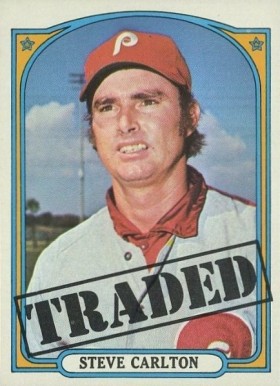
In 1972 he compiled a 7-7 record. His 7 wins was 2nd on the team after Steve Carlton’s 27 wins. (Such was the sad state of the Phillies’ pitching staff that year.)

Darrell was released by the Phillies after the 1973 season. He played for their AAA team in 1974 before retiring.

Fun Fact: Brandon wore #32 for the Phillies in 1971, before switching to #30 with the arrival of Steve Carlton in 1972. Carlton’s number was subsequently retired by the Phillies.

It’s odd that both Baseball-Reference.com and Wikipedia.org refer to him as “Bucky Brandon”. I don’t ever remember seeing his baseball cards without “Darrell” as his name. Although Baseball-Reference will redirect “Darrell Brandon” queries to their Bucky Brandon page, Wikipedia has no knowledge of a “Darrell Brandon”. 

Sunday, October 23, 2016

Rich Rollins (#243)

This is Rich Rollins’ final card as a Twin. After the 1968 season he joined the expansion Seattle Pilots.

Rollins was signed by the old Washington Senators in 1960. Midway through the 1961 season, he made his major-league debut for the team, in their first season as the Minnesota Twins.


In 1962, Rich hit .298, collected 96 RBI, and made his only All-Star team, as he started 158 of the team’s 163 games at the hot corner (every game except the 5 from 9/13 to 9/18).

The Twins had some iron-men that season: 
Bernie Allen – 158 starts at 2B 
Rich Rollins – 158 starts at 3B 
Zoilo Versalles – 157 starts at SS 
Harmon Killebrew – 150 starts in LF, 2 at 1B 
Lenny Green – 147 starts in CF, 4 in LF 
Earl Battey – 143 starts at C 
Vic Power – 141 starts at 1B 
Bob Allison – 139 starts in RF 

Rich was the Twins’ everyday 3rd-sacker for the next 2 years, starting 132 and 146 games there. In 1964 he led the AL with 10 triples.

In 1965 his starts were down to 110 (plus 12 starts at 2nd base). The decrease was due to Killebrew having moved in from left field beginning in 1965. Although Killer primarily played 1st base, he started 40 games at 3rd in an effort to keep Don Mincher’s bat in the lineup. Rollins’ days as an every-day player ended after 1965.

Killebrew started 103 games at 3B, to Rollins’ 59 games in 1966. Still, Rich appeared in another 30 games as a pinch-hitter and defensive replacement.

With Mincher shipped off to the Angels after the 1966 season in exchange for Dean Chance, Killebrew took up full-time residence at 1st base. Rollins benefited with 90 starts at 3rd base, while jack-of-all-trades Cesar Tovar started 56 games there.

Rollins’ final season in Minnesota (1968) saw him relegated to the bench for all but 44 games, as Tovar became the primary 3rd baseman, and utility types like Frank Quilici and Ron Clark also getting some playing time.

After the ’68 season, Rich was selected by the Pilots, and began the season as the starting 3rd baseman. He started 39 of the first 62 games there, then took a seat on the bench for the rest of the season. The team used a fleet of utility players there (Gus Gil, John Kennedy, Ron Clark) before settling on Tommy Harper for the final 2 months of the season.

After playing only 14 games with the Brewers, Rollins was released in mid-May 1970. He was picked up on the same day by the Indians, and played 42 games (all but 4 as a pinch-hitter) over the remainder of his final season.

He played in 1002 games over his 10-year career.