Showing posts with label ...debut: 1966. Show all posts

Sunday, May 1, 2022

George Culver (#319)

George Culver pitched for 6 teams over 9 seasons. In that time, he appeared in 335 games, mostly as a reliever. He was only a full-time starting pitcher during his first season with the Reds (1968), and once he left the Cardinals in June 1970, he never started another game.

He was originally signed by the Yankees in May 1963 (I did not know that). After that season the Indians claimed him in the first-year draft. 

Culver made his major-league debut in September 1966, pitching 5 games (9 innings). He led the Indians’ staff with 53 appearances during his rookie year in 1967, but was traded away to the Reds for outfielder Tommy Harper after the season. 

As mentioned, he was a starting pitcher in 1968, and posted career highs in wins (11), innings (226), and strikeouts (114). He also pitched a no-hitter against the Phillies that summer. The following year he moved to the bullpen, but also started 10 consecutive games in June and July. 

After the 1969 season he was on the move again, this time to the Cardinals for veteran pitcher Ray Washburn. He hardly had time to unpack when he was shipped off to the Astros in June for Jim Beauchamp and Leon McFadden. George found a home in the Astros’ bullpen for the next 2 ½ seasons, as a setup man for closer Fred Gladding. 

The Dodgers purchased his contract during spring training in 1973, but by August they put him on waivers, where he was claimed by the Phillies. 

Culver finished out his career pitching for Philadelphia for the last 2 months of ’73 and the first half of 1974. He was released at the end of June. 

He pitched the remainder of ’74 and part of ’75 for the Phillies’ AAA team, then finished up 1975 in Japan. George also made a few appearances for Phillies’ minor league teams in ’81, ’82, and ’85, but that was as a temporarily re-activated pitching coach. 

He spent 30 years as a minor-league manager and coach in the Phillies’ and Dodgers’ organizations.


Thursday, December 24, 2020

Ken Suarez (#218)

Ken Suarez was a backup catcher for the Athletics, Indians, and Rangers from 1966-73.

Suarez was signed by the Kansas City Athletics in 1965 and made his major-league debut in April 1966. He started 26 games as a rookie, behind regular backstop Phil Roof.

He made 22 starts in 1967 (still playing behind Roof) but had to compete with Dave Duncan (3 years younger than Suarez) for the #2 spot.

After the ’67 season he was selected by the Indians in the Rule 5 draft, and spend the next 2 seasons as the Tribe’s 3rd-string catcher.

In 1968 he was with the team for the whole season, but only played 17 games (1 start), with Joe Azcue and Duke Sims doing most of the catching. In ’69, he was behind Sims and rookie Ray Fosse, and spent part of the season in the minors.

After languishing in the minors in 1970, he returned to Cleveland in 1971 and saw his most action to date (50 games, 39 starts, 123 at-bats). Still, he was stuck behind All-Star and Gold Glove winner Fosse.

Ken was part of an 8-player trade with the Rangers after the 1971 season. He backed up Dick Billings in 1972 but started 88 games in 1973 (to Billings’ 67 starts). Unfortunately that was his last hurrah.

In 1974 the Rangers were going to go with rookie Jim Sundberg behind the plate, and after Suarez filed for arbitration he was traded back to the Indians for Chico Cardenas. He ended up sitting out the season due to contract issues, but in mid-September the Indians traded him to the Angels for Frank Robinson. (So in a year where he did not play, he was traded twice for ex-Reds’ All-Stars!) 


Saturday, April 25, 2020

Larry Haney (#42)

Check out the infamous 1968 and 1969 Larry Haney cards.
He’s right-handed! He’s left-handed! He’s ambidextrous!


Larry Haney was signed by the Orioles in 1961, and after 5 ½ seasons in the minors was promoted to Baltimore in late-July 1966. He played 20 games that season.

Over the first 100 games, The Orioles started Andy Etchebarren 86 times, Vic Roznovsky 12 times, and Camilo Carreon 2 times. (Charlie Lau was also on the roster, but by then he was only pinch-hitting.)

Haney was called up in time for game #101, and over the next 2 weeks he started 8 games, giving Etch some much-needed rest. Larry started 15 times over the final 60 games (with Roznovsky making 13 starts). Etchebarren started 32 games, including a 19-game stretch that included both ends of two doubleheaders. (What was the manager thinking?)

Anyway, in 1967 Haney took over as the #2 backstop, starting 45 games.

Haney missed the first half of 1968, with only 3 of his games coming before June 28th. He wasn't in the minors, so was either injured or nailed to the bench. Elrod Hendricks joined the team at the start of 1968, and with "Clank" Blefary also catching 38 games, Haney was relegated to 4th-string catcher.

After the season, Larry was selected by the Seattle Pilots in the expansion draft. He started 15 of the first 50 games for the Pilots, but by mid-June was traded to the Athletics for 2nd baseman John Donaldson. He finished out the 1969 season with Oakland, but spent much of 1970-73 in the minors, mostly in the A's organization but also on the Padres' farm in 1972.

Haney returned to the majors with the Athletics from 1974-76. In '74, he shared the catching load with Ray Fosse and Gene Tenace. After playing sparsely in 1975, he and Tenace split the catching assignments evenly in 1976 (with Haney catching whenever Tenace played 1st base).

After the 1976 season, Haney was acquired by the Brewers. He started a third of the games in 1977 (backing up Charlie Moore), He was the team’s bullpen coach in 1978 but was activated for the final 2 weeks of the season.

Haney was a coach for the Brewers from 1978 to 1991, and continued to work for the team until 2006.

His son Chris was a pitcher for the Royals and others from 1991-2002.

Monday, March 16, 2020

John Donaldson (#244)

John Donaldson played 6 seasons from 1966-1970, and in 1974, all for the Athletics except for playing the 2nd half of 1969 with the Seattle Pilots.

Donaldson was signed by the Twins before the 1963 season, and drafted by the Kansas City Athletics after his first season. He played in the Athletics’ farm system for the next 3 seasons, initially as a shortstop until making the switch to 2nd base in 1966.

John made his major-league debut in late-August 1966, playing 15 games over the final weeks of the season.


After starting the 1967 season in AAA, he joined the Athletics in early-June and started 100 of the final 110 games at 2nd base, pushing incumbent Dick Green over to a 3rd base rotation with Danny Cater and Sal Bando.

In 1968 he started 81 of the first 103 games at 2B, then was replaced by Green and only made 9 more starts for the rest of the season, including three at 3rd base.

Donaldson found a seat on the bench in 1969, his only start coming in the first game of a May 30th doubleheader. On June 14th he was traded to the Seattle Pilots for backup catcher Larry Haney. He returned to regular playing time with the hapless Pilots, starting 91 of the final 107 games.

In mid-May 1970, the Brewers traded him back to the Athletics for shortstop Roberto Pena. John returned to the backup role he had from mid-‘68 to mid-‘69.

Donaldson didn’t make the team in 1971, and spent the next 3 years in the minors – bouncing to the Tigers, Orioles, and Padres, but never playing for any of them.

He was released by the Padres in April 1974 and signed with the Athletics. He spent most of his final season in the minors, but did play 9 games for the Athletics in April and May, and one in October.

Saturday, September 14, 2019

Ed Stroud (#31)

This is Ed Stroud’s first solo card.  He previously appeared on a White Sox Rookies card (with Walt Williams) in the 1967 set.

Stroud began his career in the White Sox organization in 1963. His nickname of “Streak” was due to his stealing 74 and 72 bases in his first two minor-league seasons! After 4 seasons in the minors, he made his Sox debut in September 1966.


In mid-June 1967 he was traded to the Senators for veteran outfielder Jim King. (The first of King's two trades that season.) It was a good move for Stroud, who was stuck behind Tommie Agee, Ken Berry, Pete Ward, and rookie Walt Williams in the Sox’ outfield.

Ed played 79 games in center field over the 2nd half of the ’67 season, sharing the starts with Hank Allen.

In 1968, rookie Del Unser took over the center field job, so Stroud moved over to the right field mix with Cap Peterson, Fred Valentine, and others. Ed led the pack with 52 starts. He also played in left field occasionally when Frank Howard was at first base.

The arrangement in 1969 was much the same as in ’68, except now Ed had Lee Maye above him in the pecking order.

1970 was a career year for Stroud. Unser was limited to 100 or so games, and half of them were in right field for some reason. Ed was the primary center fielder that year, starting 95 games. He had career highs in hits (115) and stolen bases (40).

All that quality play in 1970 got him a ticket out of Washington, as he was traded back to the White Sox for 1st baseman Tom McCraw during spring training in 1971. Stroud played in 50+ games over the first half (rarely starting) and by midseason he was back in the minors, and retired after the season.

Stroud passed away in 2012 at age 72.

Saturday, August 31, 2019

Steve Whitaker (#383)

Here is outfielder Steve Whitaker, in his last season as a Yankee.

Whitaker was one of a long line of Yankees' outfielders (along with Roger Repoz, Bill Robinson, Roy White, Bobby Murcer, and Jerry Kenney) who were touted as, if not the next Mickey Mantle, then the next Roger Maris or surely the next Tom Tresh. (Only White and Murcer panned out for the Yankees. )


Whitaker was signed by the Yankees in 1962, and played in the minors from 1962-65. He bashed 27 homers in ’64 and 24 in ’65. He also hit 20 homers in 1966 before his August call-up to the Yankees.

In 1967 he started 108 games in the outfield (mostly in right field, replacing the traded Maris), but only hit 11 home runs while batting at a .243 clip.

Steve split the 1968 season between the Yankees and triple-A, then was selected by the Royals in the expansion draft.

During spring training in 1969, he was traded to the Seattle Pilots for disgruntled rookie Lou Piniella (who went on to win the Rookie of the Year award). Whitaker didn’t fare as well as Piniella. He couldn’t find regular work with the expansion team, and was used mostly as a pinch-hitter, while also spending all of August back in triple-A.

After the 1969 season he and outfielder Dick Simpson were traded to the Giants for pitcher Bob Bolin. He only played 16 games for the Giants (the last on May 9th) and played the remainder of 1970 for the Giants’ AAA team.

Whitaker played for the Padres’ AAA team in Hawaii in '71 and '72 before retiring.

 --

Having not collected baseball cards in 1970 or 1971, I lost track of Whitaker's career after 1969 until today, because by the time I was buying cards again in 1972, Steve had retired. His final card is in the 1971 set.

Friday, May 31, 2019

Cecil Upshaw (#286)

Cecil Upshaw was the Braves’ top relief pitcher from mid-1967 through the 1972 season.

Upshaw was signed by the Braves in 1964, and made his major-league debut on October 1, 1966.

In 1967, he was recalled from the minors when closer Phil Niekro moved to the starting rotation in mid-July. Upshaw remained in the closer role through the end of the 1972 season, except for missing the entire 1970 season with an injury.


In 1970 he tore ligaments in his hand in a freak accident. I had always heard that his ring finger got caught in a basketball net while attempting to dunk the ball, but on Wikipedia it says he and some teammates were walking down a sidewalk, and jumping up to touch overhanging awnings. Then his ring got caught on the awning and that was that.

In any case, Upshaw led the Braves in saves every season from '68-'72 except for 1970. In each season prior to the injury, his ERA was under 3.00, and he won a career-high 11 games in 1971.

After the 1972 season, the Braves acquired reliever Danny Frisella from the Mets, and the following April Upshaw was traded to the Astros for outfielder Norm Miller.

Cecil played just one season (1973) with the Astros, then was traded to the Indians in November for pitcher Jerry Johnson.

By late-April 1974 he was shipped out to the Yankees in a 7-player deal that saw Fritz Peterson and Chris Chambliss change teams. Upshaw played 1 season in the Big Apple, as the #2 reliever behind Sparky Lyle.

He was traded to the White Sox before the 1975 season. He manned the #10 spot on a 10-man staff in his final season, and was released during Spring Training in 1976.

Upshaw passed away in 1995 at age 52, of a heart attack.

Sunday, May 12, 2019

Tom Phoebus (#97)

Tom Phoebus was the first of a “second wave” of starting pitchers to come up through the Orioles’ farm system in the late 1960s.  This group included Jim Hardin (who we just looked at in the previous post on this blog) and Dave Leonhard, and came a year or 2 after the Dave McNally / Wally Bunker / Jim Palmer group.

Phoebus really stepped up for the Orioles in his rookie season of 1967, leading a pitching staff decimated by injuries to McNally, Bunker, and Palmer. (Hardin would join the team by mid-season.)

A Baltimore native, he was signed by the Orioles in June 1960 and played in their organization until making his major-league debut in September 1966. Phoebus pitched shutouts in his first 2 major-league starts, only the 4th AL pitcher to have done so.


Tom led the team with 14 wins in 1967 – the only pitcher with double-digit wins. He was named the Sporting News Rookie of the Year in 1967. He also won 15 games in ’68 and 14 games in ’69.

1970 saw him slump to a 5-5 record, but by that time McNally had returned to his old form (leading the AL with 24 wins in 1970 and in the middle of a 4-year 20-game win streak). The O’s also had Mike Cuellar on board now, who won the AL Cy Young award in 1969 and whose 24 wins in 1970 co-led the AL with McNally. Even Jim Palmer was back on top, beginning a streak of four 20-win seasons in 1970. My point is, Phoebus had done his job from 1967-69, holding down the fort until the big guns arrived.

Phoebus played for 2 more seasons after 1970, but never won more than 3 games again. In December 1970 he was traded to the Padres in a 6-player deal that brought pitcher Pat Dobson to Baltimore (we all know how THAT turned out).

In late-April 1972 he was sold to the Cubs, where he pitched unremarkably for the remainder of his final season.

That October he was traded to the Braves for infielder Tony LaRussa. Phoebus pitched for the Braves’ AAA team in 1973 before retiring.

Tuesday, July 3, 2018

Mike Andrews (#502)

This is Mike Andrews’ first solo card (having previously appeared on a Red Sox Rookies card in the 1967 set). Mike is fresh off his rookie season with the 1967 Impossible Dream BoSox. I was surprised today to see that Andrews had a relatively-short 7-year career (not counting his 5 games in 1966).

Signed by Boston in 1961, he played for 5 seasons in the minors (1962-66) – mostly as a shortstop, until switching to 2nd base for 1966.


Mike made his major-league debut in September 1966, then took over the starting 2nd base job with the Red Sox as a rookie. After riding the bench for the first 6 games in 1967, Andrews started 135 games that season, and played in 5 of the 7 World Series games, batting .308 in the Fall Classic.

He was the team’s regular 2nd baseman through 1970. In ’69, Mike made his only All-Star team, and hit .293 that year, along with 15 homers (more than double the previous year).

With newly-acquired rookie Doug Griffin ready to take over the 2nd base job in 1971, Andrews was traded to the White Sox for shortstop Luis Aparicio. In Chicago, Mike split the 2nd base job with Rich McKinney, while also starting a few dozen games at 1st base in relief of Carlos May.

In 1972 he was the full-time 2nd baseman, starting 143 games there. That was to be his last year as a regular, probably thanks to his batting average dropping to .220 from the .282 he hit the previous season.

Andrews was used mostly as a DH in 1973. After only starting 35 of the first 90 games, he was released on July 16th.

Two weeks later he was picked up by the Athletics, and was reunited with his old Red Sox manager Dick Williams. Andrews played 18 games over the final 2 months of the season. He also played 2 games each in the ALCS and the World Series.

There was a ruckus during that World Series, when owner Charlie Finley tried to fire Andrews after making 2 errors in 1 game. The commissioner forced Finley to reinstate Andrews, but he was subsequently released in November, ending his major-league career.

Andrews played 123 games in Japan during 1975, then retired.

His younger brother Rob Andrews played for the Astros and Giants from 1975-79.

Sunday, June 10, 2018

Felix Millan (#241)

Here is Braves' 2B Felix Millan. 1968 is the year he finally nailed down a starting job, after some brief playing time in '66 and '67.

"The Kitten" began the season as the team's starting 2nd-sacker in 1968. By mid-June, last year's starter (Woody Woodward) was traded away to the Reds in the 6-player Clay Carroll-for-Milt Pappas deal, leaving plenty of playing time for Millan, who started 143 games while posting a .289 batting average.


Felix continued his fine play for four more seasons with the Braves. He made the All-Star team every year from 1969-71, and won Gold Gloves in 1969 and 1972. He also hit a career-high .310 in 1970.

After the 1972 season he was traded to the Mets with pitcher George Stone for pitchers Gary Gentry and Danny Frisella. Millan played for the Mets for 5 seasons, the first 4 as their regular 2nd baseman.

His final season was 1977. Felix started the year as the regular 2nd baseman, but by mid-May was alternating with Lenny Randle, Doug Flynn, and Joel Youngblood. Millan started 81 games that year, but at age 33 with his batting average dropping 35 points from the previous season, the Mets decided to go with Flynn for the following season.

Millan played in Japan from 1978-80. After winning the batting title in 1979, he had a bad year in '80 and was released after the season.

Friday, May 25, 2018

Joe Foy (#387)

Here is Joe Foy, in his third and final season with the Red Sox. After the 1968 season, he was selected by the expansion Kansas City Royals.

Joe was signed by the Twins in 1962 (I did not know that!) and played one season on their farm as a 1B/C. After the ’62 season he was drafted by the Red Sox in the minor league draft. In ’63 he moved over to SS and 3B, and was primarily a 3rd baseman during the ’64 and ’65 seasons.

Foy made the Red Sox at the start of the 1966 season, and was the regular 3rd baseman from the get-go. The Sox had released incumbent Frank Malzone in November 1965, paving the way for Joe to start 139 games at the hot corner (along with 13 more at SS) during his rookie season. He hit .262/15/63 – not bad for a rookie.


Joe started only 106 games the following season, as the BoSox acquired veteran infielder Jerry Adair for their pennant drive, and he cut into Foy’s playing time. Adair played a lot at shortstop in 1968, which benefited Joe, as he started 144 games at 3rd base. It was Foy’s last hurrah in Boston. After the season, both he and Adair were drafted by the Royals (Foy at #4, Adair at #51).

Foy was the Royals’ starting third baseman for 1 year only. Although leading the upstart Royals in games, plate appearances, at-bats, runs, and RBI, and second in hits, stolen bases, and walks, Joe was traded to the Mets after the 1969 season. (The Mets, in their never-ending search for a 3rd baseman, sent rookie outfielder Amos Otis to Kansas City.)

 In 1970 Foy started about 2/3 of the games at 3rd base, while 2nd-year man Wayne Garrett played the rest. Joe’s numbers were way down from his years with Boston and Kansas City, so much so that he was available in the post-1970 Rule 5 draft, and scooped up by the Senators.

Nomad Joe started 36 of the first 45 games in 1971 for the Senators, his last on May 27th. He was sent to the minors at the end of May, and after batting only .191 in 15 triple-A games was released in mid-July.

Foy passed away in 1989 at age 46.

Saturday, January 20, 2018

Hank Allen (#426)

Hank Allen is the older brother of Phillies and White Sox slugger Dick Allen. Dick, Hank, and their younger brother Ron all came up through the Phillies’ farm system.

Hank was signed by the Phillies in 1960, and played in their organization for 5 years, mostly at 1st base but also some time in the outfield. After clubbing 25 and 37 homers in ’61 and ’62 (playing Class B, C, and D ball), he was promoted to single-A Miami in 1963.

Allen only managed 6 homers in 1963 and 12 homers at double-A Chattanooga in 1964. It seems the Phillies may have soured on his power outage, and sold him to the Senators before the 1965 season.

Hank’s power returned somewhat with the change of scenery (23 homers at AAA Hawaii in 1966), and he made his major-league debut in September 1966.


In 1967 Allen split the center field job evenly with Fred Valentine and newcomer Ed Stroud. In 1968, rookie Del Unser started almost every game in center field, leaving little room in the crowded Senators’ outfield for Allen. He spent half that season in triple-A.

In 1969 Hank was back with the Senators full-time, splitting the right field job with Stroud and Lee Maye. Allen was 3rd among the outfielders in innings played (behind Frank Howard and Unser).

In May 1970 Allen was traded to the Brewers for outfielder Wayne Comer, but spent most of that year in the minors. After the season he was flipped to the Braves for veteran catcher Bob Tillman, but was released in April 1971 and played in the minors that year.

Hank was out of baseball for most of 1972, then was signed by the White Sox when rosters expanded on September 1st. He provided bench depth for the remainder of that year and all of 1973.

In 1974 he played briefly for the Padres’ AAA team in Hawaii, where he had played for most of 1966 as a Senators’ farmhand.

After his playing career Hank became a Thoroughbred horse trainer, and more recently worked as a scout for the Astros.

Saturday, December 30, 2017

Darrell Brandon (#26)

I learned today that Darrell Brandon was not always a pitcher.

He was signed by the Pirates in 1959, but was traded to the Cardinals and played for their class-D team in 1960, as a 3rd baseman and outfielder.

After being out of baseball for the 1961 season, he resumed his baseball career as a pitcher. Darrell played in the Houston Colt .45s' farm system from 1962-65, then was traded to the Red Sox for pitcher Jack Lamabe in September 1965.

Brandon made the majors at the start of the 1966 season, and was with the Red Sox for all of ’66 and ’67. He both started and relieved during his first 2 seasons with Boston, but developed arm problems during 1967 that caused him to spend most of 1968 in the minors, although he did pitch 8 games for the Sox that season.


After the ’68 season he was selected by the Seattle Pilots in the expansion draft. Brandon only played 8 games for the Pilots, and by mid-July was sold to the Twins. He also played for both organizations’ triple-A clubs in 1969.

Released by the Twins in April 1970, he was quickly signed by the White Sox, but played the entire ’70 season for their AAA club.

Darrell returned to the majors in 1971 with the Phillies, following a January trade for infielder Rick Joseph. Brandon pitched out of the Phillies’ bullpen (behind Joe Hoerner and Dick Selma) for the next 3 seasons, appearing in 130 games (only 6 as a starter).


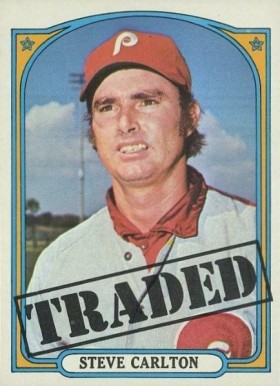
In 1972 he compiled a 7-7 record. His 7 wins was 2nd on the team after Steve Carlton’s 27 wins. (Such was the sad state of the Phillies’ pitching staff that year.)

Darrell was released by the Phillies after the 1973 season. He played for their AAA team in 1974 before retiring.

Fun Fact: Brandon wore #32 for the Phillies in 1971, before switching to #30 with the arrival of Steve Carlton in 1972. Carlton’s number was subsequently retired by the Phillies.

It’s odd that both Baseball-Reference.com and Wikipedia.org refer to him as “Bucky Brandon”. I don’t ever remember seeing his baseball cards without “Darrell” as his name. Although Baseball-Reference will redirect “Darrell Brandon” queries to their Bucky Brandon page, Wikipedia has no knowledge of a “Darrell Brandon”. 

Saturday, November 19, 2016

Mike Epstein (#358)

Mike Epstein was a slugging 1st-sacker for the Senators in the late-1960s. This is his first solo card, after appearing on an Orioles Rookies card in the 1967 set.

Prior to being signed by the Orioles in 1964, Epstein was a member of the US Olympic baseball team that won the gold medal that year.


Missing from the back of his card is his time playing for the Orioles’ Florida State Instructional League (rookie ball) team for 3 seasons from 1964-66. He played most of 1965 in class A ball and most of 1966 in AAA ball, and clubbed 30 and 29 homers respectively, along with topping 100 RBI in both seasons.

He made his major-league debut in September 1966, but realizing he was stuck behind Boog Powell at first base, he demanded a trade. After cooling his heels on the O’s bench for 2 months of 1967, he was traded to the Senators in late-May (along with pitcher Frank Bertaina) for pitcher Pete Richert. In his first at-bat against his old team, Epstein hit a grand slam.

Mike was the Nats’ regular 1st baseman for 3 seasons, starting 107, 115, and 118 games from 1968-70. (Left fielder Frank Howard started most of the remaining games at 1B.) however, his numbers were down from his minor-league stats. His best season was 1969 – reaching 30 HR and 85 RBI.

In May 1971, he and pitcher Darold Knowles were shipped to the Athletics for pitcher Paul Linblad, 1st baseman Don Mincher, and backup catcher Frank Fernandez.

Following the 1972 season, he moved on to the Texas Rangers, but after only 27 games with Texas, he was flipped to the Angels in a 5-player deal. He was the Angels’ 1st baseman for the remainder of the ’73 season.

Epstein started 18 of the first 21 games in 1974, but he and his .161 batting average were released when the calendar hit May.

Thursday, October 1, 2015

Pat Jarvis (#134)

Pat Jarvis pitched for the Braves for 7 seasons (1966-72) before wrapping up his career in 1973 with the Expos.

Jarvis was signed by the Cubs (I did not know that) in 1960 and after one season on their farm he moved on to the Tigers’ organization. After the 1963 season, he went to the Braves in a minor-league deal for pitcher Bruce Brubaker.


Pat made his major-league debut in August 1966, and was a key member of the Braves' starting rotation from 1967-70, winning 15, 16, 13, and 16 games in those seasons, and leading the staff in wins during the ’68 and ’70 seasons. He also started one game in the 1969 NL playoffs.

In 1971 he slumped to a 6-14 record, and was relegated to the bullpen for 12 of his 35 appearances. He bounced back in 1972 with a 11-7 record, but it was almost all as a reliever.

Before the ‘73 season, Jarvis was traded to the Expos for pitcher Carl Morton. This was to be his final major-league season, pitching only 39 innings (all in relief) while compiling a 2-1 record. His final game was on September 23rd.

Pat was dealt to the Rangers in December, but was released in March 1974, ending his 8-year career.

Sunday, June 15, 2014

Don Sutton (#103)

Here is future Hall-of-Fame pitcher Don Sutton, about to enter his 3rd season. His 1966 rookie season was also Sandy Koufax’ final season.

Sutton was signed by the Dodgers in 1964, and pitched only 1 season in the minors. He compiled a 23-7 combined record, pitching in A and AA ball in 1965. Don made his big-league debut in April 1966 as the #4 starter behind Koufax, Don Drysdale, and Claude Osteen. Sutton posted a record of 11-11 with 209 strikeouts and a 2.99 ERA.

With Koufax’ retirement after 1966, everyone moved up a notch in the starting rotation. Don posted 2 consecutive 11-15 seasons, then bounced back in 1969 with 17 wins and 217 strikeouts.


Sutton was one of the Dodgers’ top starting pitchers through the 1980 season, partnering first with Drysdale, Osteen and Bill Singer, then later on with Al Downing, Andy Messersmith, and Tommy John. He led the league with 9 shutouts in 1972, and with a 2.20 ERA in 1980. Don made the all-star team in ‘72, ’73, ’75, and ’77, and finished in the top 5 Cy Young voting every season from 1972 to 1975. Sutton also pitched in the NLCS and World Series in ’74, ’77, and ’78.

Don became a free agent after the 1980 season, and signed with the Astros. After 1 ½ seasons in Houston he was traded to Milwaukee in August ’82 for outfielder Kevin Bass and two others, as the Brewers geared-up for their first post-season.

Sutton went 4-1 in 7 starts for the rest of the season, and was 1-1 in 3 post-season games. He pitched for 2 more seasons in Milwaukee, then was traded to the Athletics after the 1984 season.

Don bounced around for the next 3 seasons from the Athletics to the Angels, before finishing his career in 1988 with the Dodgers. He was a starting pitcher right up to the end, finally getting his release on August 10, 1988. Sutton pitched for 23 seasons, amassing 324 wins and 3574 strikeouts.

In 1998, Sutton was inducted into the Hall of Fame, and also had his #20 retired by the Dodgers.

Sutton has been broadcasting baseball games since 1989, mostly for the Braves.

Thursday, March 7, 2013

Dick Hughes (#253)

Today I’m featuring the last of the 1967 Topps All-Rookie selections. Normally, 10 players were selected (including 1 left and 1 right handed pitcher). In the 1968 set, Topps not only left the cool trophy off 3 of the cards, but they decided that Dick Hughes would share the right-handed pitcher slot with Tom Seaver. (Imagine!)


Hughes was signed by the Cardinals in 1958, but was a late-bloomer, pitching 9 seasons in the minors before reaching the majors in September 1966 at age 28.

He had a phenomenal rookie season for the World Champion Cardinals in 1967, compiling a 16-6 record in 37 games (including 27 starts), while leading the staff in wins and innings pitched. (Bob Gibson missed a month of the season with a broken leg.) Dick finished second in the NL Rookie of the Year voting to Seaver.


Hughes spent most of the 1968 season in the bullpen, starting just 5 of his 25 games, and finishing at 2-2 in only 63 innings of work. What a difference a year makes! In the 1967 World Series, Dick started 2 games. In ’68, he pitched 1/3 of an inning in relief against the Tigers.

I’m guessing he had arm troubles, because he spent the 1969 season playing in the single-A Florida State League, then was out of baseball at the ripe old age of 31.

Saturday, February 23, 2013

Rich Nye (#339)

For some unknown reason, three of the players on the 1967 Topps all-rookie team do not have trophies on their card. I have previously posted the card for outfielder Rick Monday, leaving only pitchers Rich Nye and Dick Hughes to complete the subset.

Rich Nye was the lefthanded pitcher chosen for the 1967 Topps all-rookie team. Nye pitched from 1966-70, although his primary years were 1967-69 for the Cubs.

Rich was drafted by the Astros in 1965, but did not sign. He was signed by the Cubs in 1966, while pitching for UC Berkeley. Nye pitched for the Cubs' rookie and class-A teams that summer, then joined the big club in September.


After 2 relief appearances in 1967, Nye joined the starting rotation on April 30th, after other starters went by the wayside. He finished his rookie season with 13 wins and 119 strikeouts in 205 innings. All three of those numbers placed him 2nd on the staff, behind sophomore Fergie Jenkins. Topps apparently took notice (despite the missing trophy).

Nye slipped to 7-12 in 1968, and dropped to #5 in the rotation, behind Jenkins, Bill Hands, Ken Holtzman, and Joe Niekro. 1969 was worse yet, as he was relegated to the bullpen, making only 5 starts among his 34 appearances.

After the season, he was traded to the Cardinals for outfielder Boots Day. (Philly trivia: As a Montreal Expo in 1971, Boots was the first batter in Veterans Stadium history.) After 6 relief appearances (totaling 8 innings), Rich was sold to the Expos on May 15th, where he made 6 starts and 2 relief appearances. He was also used as a pinch-runner twice, and spent time with the Expos' AAA team in Winnipeg.

He played for three AAA teams (Expos, Indians, Pirates) in 1971, before his career was ended by a torn rotator cuff.

After his playing career, Nye began working as a civil engineer, before becoming a veterinarian.

A Rich Nye story here


Monday, February 11, 2013

Reggie Smith (#61)

Since I posted Walt Williams' card some time ago, I'm skipping ahead to center fielder Reggie Smith.

Reggie Smith was the starting center fielder for the AL champion Red Sox during his rookie season. His rookie card appears in the 1967 set. My guess is that it's the 3rd most valuable rookie card (after Tom Seaver and Rod Carew) because unlike most Rookie Stars cards that include a hit and a miss (or 2 misses), it portrays 2 starting position players for the AL champs.


Smith was signed by the Twins in June 1963, and played 65 games as a shortstop for their rookie-level team. After the season he was selected by the Red Sox in the first-year player draft.

Reggie played 3 seasons in Boston's farm system, as an outfielder for 430 games, but also saw time at 3rd base (66 games) and 2nd base (37 games). He made his debut with the Red Sox in September 1966, playing in 6 games.

Smith began the 1967 season as the starting 2nd baseman, but after 6 games he was moved to center field (replacing Jose Tartabull) and went on to start 139 games in Center that season. Reggie finished 2nd to Rod Carew in the AL Rookie of the Year voting, and was 6-for-24 with 2 homers in the '67 World Series.

Reggie was a starting outfielder for the Sox from 1967 through 1973, usually the center fielder, except for the first half of 1971 (Smith played right, with Billy Conigliaro in center) and all of 1972, when he was the regular right fielder (with Tommy Harper in center). He also made the '69 and '72 all-star teams, and led the AL in doubles in '68 and '71.

After the 1973 season, Reggie was traded to the Cardinals (with pitcher Ken Tatum) for pitcher Rick Wise and outfielder Bernie Carbo. His stay in St. Louis lasted 2 1/2 seasons. In '74 he was the right fielder, and in '75 split his time between RF and 1st base. Smith made the NL all-star team in both his full seasons with the Cards.

He was traded to the Dodgers in June 1976 for catcher Joe Ferguson. Smith was with the Dodgers for 5 1/2 seasons, making the all-star team 3 more times (for a total of 7 appearances).

His final major-league season was spent with the Giants in 1982 as their first baseman.

Smith played 2 more seasons in Japan before retiring.

Tuesday, January 22, 2013

Tim Cullen (#209)

Moving around the horn, we come to Tim Cullen, the Topps all-rookie shortstop in 1967.

Cullen was signed by the Red Sox in 1964 out of Santa Clara University, and reported directly to triple-A Seattle. After his first season (as a 3rd baseman), he was drafted by the Senators, and played another season and a half in triple-A (now as a shortstop), before he was called up in early August 1966. Tim played 18 games with the Sens over the rest of the season.

Tim made the Senators at the start of 1967, and was a spot-starter at 2B and 3B early in the season. On July 5th, he wrested the starting shortstop job away from light-hitting Ed Brinkman, and started 62 of the final 84 games there.

That was good enough to snag the Topps All-Rookie post, but prior to the 1968 season, Cullen was traded to the White Sox (with pitchers Bob Priddy and Buster Narum) for shortstop Ron Hansen and pitchers Dennis Higgins and Steve Jones.


Chicago had also re-acquired shortstop Luis Aparicio from the Orioles in the off-season, so Cullen was installed at 2nd base. Tim held a regular job from day 1 until mid-June, then was relegated to the bench in favor of Sandy Alomar.

By early August, Cullen was returned to Washington in exchange for Hansen. (Cullen and Hansen are the only 2 players to ever be traded for each other twice in the same season.) For the remainder of 1968, and for 2 more seasons, Tim shared the starting 2nd base job with Bernie Allen.

In 1971, he split his starts between 2nd base and shortstop, as the Senators were easing rookies Lenny Randle (2B) and Toby Harrah (ss) into the starting lineup. Cullen followed the team to Texas in 1972, but was released by the Rangers in spring training.

A month later, the Athletics picked him up, and he began his final season in triple-A, before the A's recalled him in late June. Tim and ex-Indians' shortstop Larry Brown split the 2nd base job for the bulk of the season, as veteran A's 2nd-sacker Dick Green missed most of the '72 season.