Showing posts with label ...baseball brothers. Show all posts

Tuesday, July 3, 2018

Mike Andrews (#502)

This is Mike Andrews’ first solo card (having previously appeared on a Red Sox Rookies card in the 1967 set). Mike is fresh off his rookie season with the 1967 Impossible Dream BoSox. I was surprised today to see that Andrews had a relatively-short 7-year career (not counting his 5 games in 1966).

Signed by Boston in 1961, he played for 5 seasons in the minors (1962-66) – mostly as a shortstop, until switching to 2nd base for 1966.


Mike made his major-league debut in September 1966, then took over the starting 2nd base job with the Red Sox as a rookie. After riding the bench for the first 6 games in 1967, Andrews started 135 games that season, and played in 5 of the 7 World Series games, batting .308 in the Fall Classic.

He was the team’s regular 2nd baseman through 1970. In ’69, Mike made his only All-Star team, and hit .293 that year, along with 15 homers (more than double the previous year).

With newly-acquired rookie Doug Griffin ready to take over the 2nd base job in 1971, Andrews was traded to the White Sox for shortstop Luis Aparicio. In Chicago, Mike split the 2nd base job with Rich McKinney, while also starting a few dozen games at 1st base in relief of Carlos May.

In 1972 he was the full-time 2nd baseman, starting 143 games there. That was to be his last year as a regular, probably thanks to his batting average dropping to .220 from the .282 he hit the previous season.

Andrews was used mostly as a DH in 1973. After only starting 35 of the first 90 games, he was released on July 16th.

Two weeks later he was picked up by the Athletics, and was reunited with his old Red Sox manager Dick Williams. Andrews played 18 games over the final 2 months of the season. He also played 2 games each in the ALCS and the World Series.

There was a ruckus during that World Series, when owner Charlie Finley tried to fire Andrews after making 2 errors in 1 game. The commissioner forced Finley to reinstate Andrews, but he was subsequently released in November, ending his major-league career.

Andrews played 123 games in Japan during 1975, then retired.

His younger brother Rob Andrews played for the Astros and Giants from 1975-79.

Sunday, March 6, 2016

Dave Ricketts (#46)

Wait... is this guy a major-league ballplayer, or a high school science teacher?

This is my first Dave Ricketts card. His rookie card (1967) was in the high-number series, so I didn’t get that until decades later. Dave had cards every year from 1967-70, and appears very scholarly on each card (see below).


Dave Ricketts was signed by the Cardinals in 1957, and played 8 seasons in the minors (missing the ’58 and ’59 seasons while in military service). He debuted with 3 games in late-September 1963, and also played in 11 games for the Cards scattered over the 1965 season.

Ricketts made the Cardinals on a full-time basis in 1967. He was one of Tim McCarver’s backup catchers for 3 seasons, and as such, he rarely played outside of some pinch-hitting appearances. Dave started 16 games in 1967, but only 1 game in 1968. (The newly-acquired Johnny Edwards was the 2nd string backstop that year.) However, Ricketts did get 3 at-bats in the 1967 World Series and 1 at-bat in the ’68 Fall Classic.

In 1969 Edwards had moved on, but the Cardinals traded for long-time Braves’ catcher Joe Torre before the season. Torre primarily played 1st base, but also made 16 starts behind the dish when McCarver needed a rest, leaving only 7 starts for Dave.

After the 1969 season, Ricketts and pitcher Dave Giusti were traded to the Pirates for backup catcher Carl Taylor. (?!?) He filled the same role for the Pirates: a seldom-used 3rd string catcher behind Manny Sanguillen and Jerry May (14 games, 12 at-bats, no starts).

Dave was released after the season, then was a bullpen coach for many years (Pirates 1971-73, Cardinals (1974-91). He was activated by the Pirates for a few weeks in 1971 but did not play.

Dave’s older brother Dick pitched for the Cardinals in 1959.

Dave Ricketts passed away from cancer in 2008 at age 73.

Thursday, August 21, 2014

Tom Haller (#185)

Tom Haller was a catcher for the Giants and Dodgers in the 1960s. Here we see him on his last card as a Giant. He was traded to the Dodgers prior to the 1968 season for Ron Hunt, but both players appear as Giants in the ’68 set.

After playing quarterback at the University of Illinois, Haller was signed by the Dodgers in 1958. After 3 seasons in the minors, Tom began 1961 with the Giants, but spent the 2nd half of the season back in the minors.

He platooned at catcher with veteran Ed Bailey in 1962 and 1963, then took over as the #1 catcher in 1964, a position he would hold through the 1967 season. Haller made the all-star team in 1966 and 1967, his final 2 seasons in San Francisco. He also clubbed a career-high 27 homers in 1966.


In February 1968 (with rookie catcher Dick Dietz ready for regular playing time) Haller was traded to the Dodgers for 2nd baseman Ron Hunt and utility infielder Nate Oliver. It was the first trade between the two teams since their move to California in 1958.

Tom was immediately installed as the starting catcher in LA, taking over for John Roseboro, who had been traded to the Twins 3 months earlier. Haller made his 3rd consecutive all-star squad in 1968, then continued as the #1 catcher in 1969.

In 1970 he started 91 games behind the plate, with backups Jeff Torborg and Bill Sudakis (the team’s starting 3rd baseman in 1969) splitting the remaining games.

In 1971, Tom shared the starting catching duties with Duke Sims (acquired from the Indians), with rookie Joe Ferguson also getting a few dozen starts as the 3rd-stringer.

Haller was traded to the Tigers after the 1971 season, and spent the ’72 season backing up perennial all-star Bill Freehan. By early August, Tom’s old pal Duke Sims was acquired from the Dodgers, and joined the catching mix. Haller only started 4 games after Sims’ arrival.

During one start in July 1972, Haller was catching, while his older brother Bill (an American League umpire) was working behind the plate.

The Phillies acquired Haller before the 1973 season, mostly to serve as a mentor and insurance policy for Bob Boone, who, after a cup of coffee in September ’72, would be handed the starting catching job in 1973. Haller decided to retire, rather than accept a trade to the Phillies.

Haller was the Giants’ GM from 1981-85, and the White Sox’ GM in 1986.

He passed away in November 2004 at age 67.

Wednesday, July 16, 2014

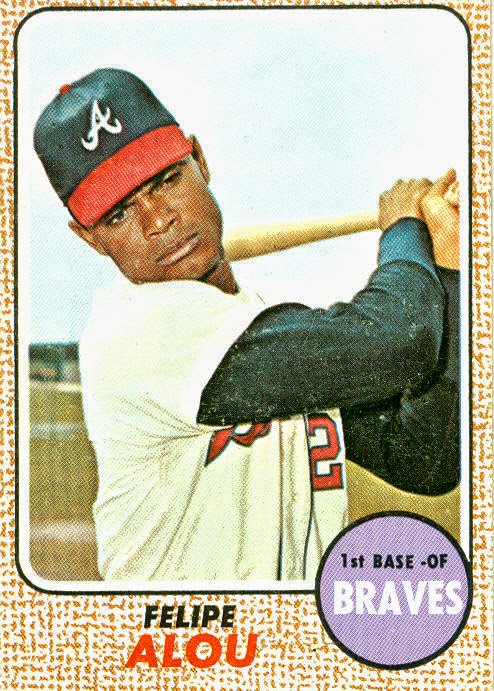
Felipe Alou (#55)

Felipe Alou played 17 seasons (1958-74) for 6 teams, mostly the Giants and Braves. Although mostly an outfielder, he played about half his games at 1st base from 1965-67 with the Braves and from 1971-73 with the Yankees.

Felipe is the oldest of the 3 Alou brothers, who all began their careers with the Giants. Felipe's son Moises also played in the majors from 1990-2008.

Alou was signed by the Giants in 1955, and played 2 ½ seasons in the minors before making his big-league debut with the Giants in June 1958. Felipe backed up rookie Willie Kirkland in right field for the remainder of the season.


1959 was more of the same for Alou, backing up Kirkland in right field. In late July, rookie Willie McCovey joined the Giants, which caused incumbent 1st baseman Orlando Cepeda to play about half his games in left field for the next few seasons. With Willie Mays in center field, all other outfielders would have to vie for playing time in right field.

In 1960 Alou was the regular left fielder for the 50+ games when Cepeda would move in to 1st base. From 1961 to 1963, Felipe was the Giants' regular right fielder, often backed up by his brother Matty. His youngest brother Jesus joined the Giants in September 1963, Felipe's last few weeks with the Giants. All 3 Alou brothers played in the same outfield only once – on September 15th.

After the season, Felipe was traded to the Braves (with pitcher Billy Hoeft, catcher Ed Bailey, and infielder Ernie Bowman) for pitchers Bob Shaw and Bob Hendley, and catcher Del Crandall. Alou began the '64 season as the Braves’ starting center fielder, but by mid-June had lost that post to Lee Maye, and spent the remainder of the season as the 4th outfielder.

Felipe began playing 1st base in 1965, and spent the next 3 seasons dividing his time between 1st, left field, and center field. He also was quite good with the stick. In 1966 he finished 2nd among NL batters with a .327 average (right behind his brother Matty). In 1968 he finished 3rd (behind Pete Rose and Matty) with a .317 average.

After Mack Jones was traded away following the 1967 season, Alou spent the next 2 seasons as the Braves' regular center fielder.

After the '69 season, he was traded to Oakland for pitcher Jim Nash. Alou only spent one full season with the Athletics. At age 35, he played in an outfield that included Rick Monday and Reggie Jackson, both 24. Felipe played in left field, and also 70 games in right (mostly when Jackson played center in Monday's absence).

Felipe started the first 2 games of the 1971 season, then at week's end was traded to the Yankees. He played the rest of '71, all of '72, and most of '73 in the Big Apple. He was a regular in 1971, playing RF/CF/1B. For the next 2 seasons he shared the first base job with Ron Blomberg.

In September 1973 Alou hit the road again, this time for Montreal. He played 19 games for the Expos during the season's final month, then was sold to the Brewers in the off-season. After 3 games with Milwaukee, he was released in April 1974.

Alou became a manager after his playing career, with stops in Montreal (1992-2001) and San Francisco (2003-06).

Sunday, October 27, 2013

Phil Niekro (#257)

Phil Niekro was signed by the Milwaukee Braves in 1958. Phil played 4 seasons in the minors (1959-62), as a reliever, then missed the 1963 season while in military service. He made the Braves’ team to begin the 1964 season, but after 10 relief appearances, he was sent down to triple-A Denver in mid-May for the remainder of the season. During that time, he became primarily a starting pitcher.

Niekro returned to the Braves for all of 1965, although he was back in the bullpen for all but 1 of his 41 games. In 1966, Phil appeared in 28 games (all in relief), but spent all of June and July in the minors.


"Knucksie" started the 1967 season in the bullpen, but joined the starting rotation on June 13th, where he would remain for the next 16 seasons. Niekro led the NL with a 1.87 ERA in 1967, and would win in double figures for the next 20 seasons (except the strike-shortened 1981 season). He led the NL in strikeouts in 1977 (262), and wins in 1974 (20) and 1979 (21). He also won 23 games in 1969.

After compiling a record of 11-10 in 201 innings in 1983, the Braves released Niekro. He was quickly signed by the Yankees, winning 16 games in each of his 2 seasons with New York. Phil was released by the Yankees during spring training in 1986, but played for the Indians for the next year and a half. Niekro was traded to the Blue Jays in August 1987, then was released at month’s end. He re-signed with the Braves for the final week of the season, then retired.

Phil pitched in 864 games during his 24-year career. His 318 career wins are the most by a knuckleball pitcher. (As kids, he and his brother Joe learned to throw a knuckleball pitch from their father.)

Niekro was inducted to the Hall of Fame in 1997. His #35 (which he wore for his entire career) was retired by the Braves in 1984, 3 seasons before his retirement.

Among his other post-retirement activities, he coached a women’s professional baseball team.

Wednesday, April 4, 2012

Gary Sutherland (#98)

This Gary Sutherland's first solo card. It's also the first of his cards that I got (in 1968), since his rookie card was in the 1967 7th series (none of which I had until the mid 1980s).

Sutherland was one of my favorite players on the 1967 Philadelphia Phillies (my introduction to MLB). Why? I don't really remember - maybe because he was an upstart rookie, getting a lot of playing time as a platoon player among so many veterans.


Sutherland was signed by the Phillies in 1964, the year after they signed his brother Darrell (and his other brother Darryl). Gary played just 2 seasons in the minors (as the fulltime 2nd baseman at double-A Chattanooga in 1965, and the fulltime shortstop at triple-A San Diego in 1966) before making the Phillies at the start of the 1967 season.

Although this card lists his position as "INF-OF", during his rookie season he only played shortstop and left field. For the first half of the season he platooned in left field with Johnny Briggs, and also played shortstop when Bobby Wine was not in the lineup. As the season wore on, the Phillies stopped platooning in left field, decreasing Sudsy's playing time.

During the 1968 season, Sutherland was relegated to utility infielder status (even with starting shortstop Bobby Wine going down for the season on May 12th with a back injury). The team recalled journeyman infielder Roberto Pena from the minors to handle the shortstop post. Sutherland only made 6 starts there to Pena's 128 starts.

After the '68 season, the Phillies lost Sutherland, Wine, and Pena to the expansion draft, with Sutherland and Wine going to the Montreal Expos. Gary was the Expos' starting 2nd baseman in their inaugural season, but shared the position with Marv Staehle in 1970. In 1971 he was the backup 2B/SS (behind starters Ron Hunt and Bobby Wine).

Sutherland spent most of 1972 and 1973 in the minors. Along the way, he was traded to the Astros in June 1972. It would take a December 1973 trade to the Tigers to get him back to the major leagues.

Gary made a comeback as the Tigers' regular 2nd baseman from the start of the 1974 season until his early June 1976 trade to the Brewers. In Milwaukee, Suds shared the 2nd base job with Tim Johnson and Jack Heidemann.

Gary was released prior to the 1977 season, and soon signed with the Padres. After the season he was released again. In January 1978 he was signed by the Cardinals, but was released in late May, ending his career.

Monday, March 12, 2012

Lee May (#487)

For 6 straight seasons in the 1960s, the Cincinnati Reds had at least one of the 10 Topps All-Star Rookies:

1963 - Pete Rose 2B, Tommy Harper OF
1964 - Bill McCool P
1965 - Tony Perez 1B
1966 - Tommy Helms 3B
1967 - Lee May 1B
1968 - Johnny Bench C

(What, no shortstop?)

Lee May was signed by the Reds in 1961, and played for 6 seasons in their farm system, mostly at first base, with a few games as an outfielder in 1964 and 1965. Those 2 seasons were big for May, as he batted over .300 and collected over 100 RBI each year. He also hit 25 and 34 homers, respectively.

Lee got a big-league cup of coffee in 1965 and another 25 games in 1966, before making the Reds for good at the start of 1967.


I always thought the arrival of Lee May in 1967 set the Reds' defense in shuffle mode: Tony Perez from 1B to 3B, Tommy Helms to 2B, and Pete Rose to the outfield. In fact, Helms and Rose had moved at the start of the season, before May cracked the starting lineup, (with Deron Johnson coming in from left field to play 3B). In early May, Perez moved from 1st to 3rd, with Johnson and May alternating chunks of games as the starting 1st baseman. (Lee also spent about a month in left field, with Rose returning to 2B and Helms to shortstop during Chico Cardenas' trip to the DL.) By the time the season was over, May had started 68 games at 1B and 47 in the outfield.

Things settled down defensively in 1968. In the off-season, Johnson was traded to Atlanta which opened up a full-time 1st base job for May. Lee began a string of 11 very productive seasons. He was with the Reds through 1971, then 3 seasons with the Astros (sent there in the Joe Morgan trade), before settling in Baltimore in 1975.

May was the Orioles' 1st baseman in his 1st season there, then eased into the DH role in '76 and '77 before becoming the full-time DH in '78 and '79. In his last 3 seasons, May was relegated to a part-time role, the final 2 with Kansas City.

Lee retired after the 1982 season. His brother Carlos was the White Sox' regular left fielder during the early 1970s.

Monday, July 5, 2010

Final Card: Darrell Sutherland

Here is the final card for Darrell Sutherland (#551). Darrell was signed by the Phillies in 1963, one year before they also signed his brother Gary. (Darrell's picture is 5 years old, as it shows him in a Phillies' uniform from his days with the class-A Bakersfield Phillies in 1963.)

In April 1964, the Mets selected him from the Phillies in the minor-league draft, and from 1964-66, Darrell was a starting pitcher with the Mets' triple-A teams. During those same 3 seasons, he appeared in 10, 18, and 32 games for the big club, mostly as a reliever.

In 1967, Sutherland spent the entire season with double-A Williamsport, where he made 38 relief appearances and 1 start. After the season, the Indians selected him in the minor-league player draft.


Darrell only appeared in 3 games for Cleveland in 1968, while spending the bulk of the season with the Indians' AA and AAA teams.

His final pro season was in 1969, where he appeared in 47 games (all in relief) for the Indians' triple-A Portland team.

Tuesday, January 19, 2010

Final Card: Larry Sherry

Here is the final card for Larry Sherry (#468). Not only does the front have a bland, hatless photo, but there is plenty of elbow room on the back. (The Topps' employee responsible for writing player commentary must have been on vacation the day Sherry's card was prepared.)

Larry was signed by the Brooklyn Dodgers in 1953 and spent 7 years in their minor-league system. After a few games with the Dodgers in 1958, Sherry saw more action in 1959, splitting time between the Dodgers and triple-A.


Sherry spent 5 seasons in the Dodgers' bullpen, his best coming in 1960, as he pitched 142 innings and compiled a 14-10 record.

At the start of the 1964 season, he was traded to the Tigers for outfielder Lou Johnson. Although Larry had made occasional starts with the Dodgers, he was strictly a reliever with the Tigers. In 3-plus seasons in Detroit, he never approached the workload he had in LA.

Sherry was well-traveled in his final 2 seasons. In late June 1967, the Tigers traded him to the Astros for outfielder Jim Landis. Although he appears on this card as an (implied) Astro, he was released in spring training 1968. It wasn't until July 1st that he found his next team. The Angels signed him, but he only made 3 appearances, the last on July 7th.

Sherry spent the remainder of 1968, as well as 1969 and 1970 playing for the Angels' and White Sox' triple-A teams.

Monday, January 18, 2010

Ken Boyer (#259)

Ken Boyer was the long-time star third baseman for the St. Louis Cardinals.

He began his minor-league career in 1949 with the Cardinals' organization. After 3 seasons in the minors, he missed the 1952-53 seasons while in military service, but returned to the minors in 1954.

His major-league debut came in April 1955, and he spent the next 11 seasons as the Cardinals' everyday third baseman, never playing less than 142 games in a season. (The exception would be in 1957, when oddly enough, Boyer was the team's regular centerfielder.) Along the way, he made 7 all-star teams, won 5 gold glove awards, and was the National League MVP in 1964. The Cardinals won the 1964 World Series, defeating the Yankees, who employed Ken's brother Clete as their third baseman.


After the 1965 season, Boyer was traded to the Mets for pitcher Al Jackson and third baseman Charlie Smith. He continued as the Mets' regular third baseman in 1966.

In July 1967, Ken was traded to the White Sox (along with Sandy Alomar) for backup catcher J. C. Martin. [This trade seems like an insult to Boyer.]

The following May, he was released by the White Sox, but signed with the Dodgers a few days later. Boyer would continue with the Dodgers until the end of the 1969 season.

After his playing career Boyer stayed in the game as a manager. After managing in the minors from 1970-1978, he was the Cardinals' manager from 1978 to 1980.

Thursday, November 5, 2009

Tony Conigliaro (#140)

Tony Conigliaro was a rising star for the Boston Red Sox in the mid-1960s. This power-hitting rightfielder was the fastest player to reach 100 homeruns, and was considered to have a chance to eventually break Babe Ruth's record. He was beaned in late 1967, and was never the same after that.

Conigliaro began in class-A ball in 1963. After just 1 year, he was up to the big club in 1964. He led the league in homeruns in his 2nd year. In August 1967, Conigliaro was hit in the eye by a pitch from the Angels' Jack Hamilton, and was out for the season, missing the World Series. In fact, although this is his 1968 card, he also didn't play at all in 1968.


He resumed his career on opening day 1969, and played in 141 games in 1969 and 146 in 1970, while hitting 20 and 36 homeruns in those seasons.

After 1970, he was traded to the Angels with Ray Jarvis and Jerry Moses for Doug Griffin, Jarvis Tatum and Ken Tatum. (Never had so many guys named Jarvis or Tatum been included in the same deal!) Tony only played in 74 games for the Angels that year (hitting only 4 homers). After being released by the Angels, Conigliaro signed with Boston again in 1975, but after 21 games (all as a DH or pinch-hitter), he was forced to retire due to permanent eye damage.

Several years later, he suffered a heart attack, and then a stroke, and remained in a coma for several years until his death in 1990.

Sunday, October 25, 2009

Tommie Aaron - Why does he have a card?

Tommie Aaron (#394) didn't have a baseball card in 1967 - and with good reason. He had no appearances with the Braves in 1966. Likewise, he appeared in a total of zero major-league games in 1967, yet here he is with a 1968 card. Where's the logic?


However, Tommie does hold the distinction of being one half of the greatest brother home-run tandem in history, with 768 homeruns (Hank - 755, Tommie - 13)!

Notice Topps' new airbrushing style of completely obliterating the front of the cap with black, a technique used with reckless abandon on the Athletics and "Houston" (Astros) cards in 1968.


Why does he have a card?