Showing posts with label ...baseball father/son. Show all posts

Saturday, April 25, 2020

Larry Haney (#42)

Check out the infamous 1968 and 1969 Larry Haney cards.
He’s right-handed! He’s left-handed! He’s ambidextrous!


Larry Haney was signed by the Orioles in 1961, and after 5 ½ seasons in the minors was promoted to Baltimore in late-July 1966. He played 20 games that season.

Over the first 100 games, The Orioles started Andy Etchebarren 86 times, Vic Roznovsky 12 times, and Camilo Carreon 2 times. (Charlie Lau was also on the roster, but by then he was only pinch-hitting.)

Haney was called up in time for game #101, and over the next 2 weeks he started 8 games, giving Etch some much-needed rest. Larry started 15 times over the final 60 games (with Roznovsky making 13 starts). Etchebarren started 32 games, including a 19-game stretch that included both ends of two doubleheaders. (What was the manager thinking?)

Anyway, in 1967 Haney took over as the #2 backstop, starting 45 games.

Haney missed the first half of 1968, with only 3 of his games coming before June 28th. He wasn't in the minors, so was either injured or nailed to the bench. Elrod Hendricks joined the team at the start of 1968, and with "Clank" Blefary also catching 38 games, Haney was relegated to 4th-string catcher.

After the season, Larry was selected by the Seattle Pilots in the expansion draft. He started 15 of the first 50 games for the Pilots, but by mid-June was traded to the Athletics for 2nd baseman John Donaldson. He finished out the 1969 season with Oakland, but spent much of 1970-73 in the minors, mostly in the A's organization but also on the Padres' farm in 1972.

Haney returned to the majors with the Athletics from 1974-76. In '74, he shared the catching load with Ray Fosse and Gene Tenace. After playing sparsely in 1975, he and Tenace split the catching assignments evenly in 1976 (with Haney catching whenever Tenace played 1st base).

After the 1976 season, Haney was acquired by the Brewers. He started a third of the games in 1977 (backing up Charlie Moore), He was the team’s bullpen coach in 1978 but was activated for the final 2 weeks of the season.

Haney was a coach for the Brewers from 1978 to 1991, and continued to work for the team until 2006.

His son Chris was a pitcher for the Royals and others from 1991-2002.

Friday, October 27, 2017

Len Gabrielson (#357)

Len Gabrielson was a corner outfielder for 5 teams in the 1960s.

He was signed by the Milwaukee Braves in 1959, and made his major-league debut for the Braves with 4 games in September 1960.

After that brief cup of coffee, it was back to the minors until 1963. That season he played 46 games with the Braves (mostly as a pinch-hitter or 1st baseman) in April, May, and September, while spending the middle of the season in the minors.


Len finally became a permanent major-leaguer in 1964. He played in 24 games for the Braves, then was traded to the Cubs in early June for catcher Merritt Ranew. Gabrielson started 71 of the Cubs’ final 84 games that year, taking over the right field job vacated with the trade of Lou Brock to the Cardinals.

In 1965, Doug Clemens (one of the players acquired for Brock in 1964) took over Gabrielson’s starting right field job, so after a handful of games Len was traded to the Giants in late May (along with catcher Dick Bertell) for pitcher Bob Hendley, catcher Ed Bailey, and outfielder Harvey Kuenn. Willie Mays and Jesus Alou had the CF and RF spots sewn up, so Len had to fight for playing time in left field with Matty Alou, Cap Peterson, and others. He did start 88 games there, more than any of the others.

Rookie Ollie Brown joined the Giants in 1966, further eating into Gabrielson’s playing time. After the season he was traded to the Angels for backup first baseman Norm Siebern.

This is where I jumped on the baseball bandwagon. My first knowledge of Gabrielson is his 1967 baseball card showing him as an Angel, but he only played 11 games for them before he was flipped to the Dodgers in May ’67 for utility player John Werhas.

Len was a corner outfield backup for most of his time with the Dodgers. His playing time spiked up in 1968, when Al Ferrara was lost for the season with a broken leg after just 2 games. Surprisingly, Gabrielson led the Dodgers with all of TEN home runs in 1968.

In Len’s final season (1970), he appeared in 43 games, all but 3 as a pinch-hitter.

His father (also Len) played briefly with the Phillies in 1939.

Wednesday, July 16, 2014

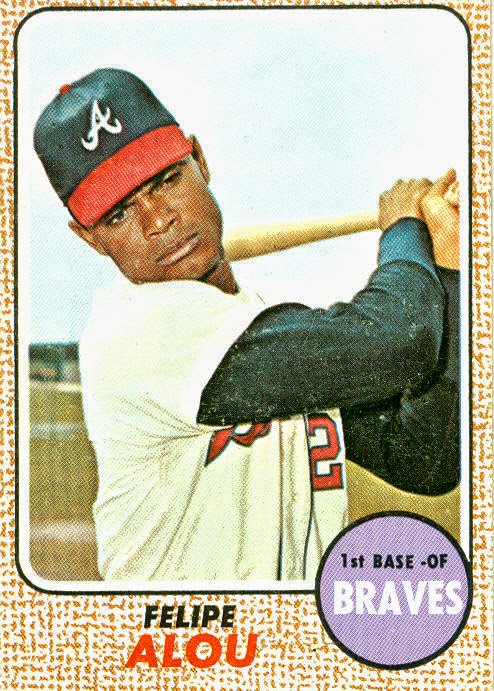
Felipe Alou (#55)

Felipe Alou played 17 seasons (1958-74) for 6 teams, mostly the Giants and Braves. Although mostly an outfielder, he played about half his games at 1st base from 1965-67 with the Braves and from 1971-73 with the Yankees.

Felipe is the oldest of the 3 Alou brothers, who all began their careers with the Giants. Felipe's son Moises also played in the majors from 1990-2008.

Alou was signed by the Giants in 1955, and played 2 ½ seasons in the minors before making his big-league debut with the Giants in June 1958. Felipe backed up rookie Willie Kirkland in right field for the remainder of the season.


1959 was more of the same for Alou, backing up Kirkland in right field. In late July, rookie Willie McCovey joined the Giants, which caused incumbent 1st baseman Orlando Cepeda to play about half his games in left field for the next few seasons. With Willie Mays in center field, all other outfielders would have to vie for playing time in right field.

In 1960 Alou was the regular left fielder for the 50+ games when Cepeda would move in to 1st base. From 1961 to 1963, Felipe was the Giants' regular right fielder, often backed up by his brother Matty. His youngest brother Jesus joined the Giants in September 1963, Felipe's last few weeks with the Giants. All 3 Alou brothers played in the same outfield only once – on September 15th.

After the season, Felipe was traded to the Braves (with pitcher Billy Hoeft, catcher Ed Bailey, and infielder Ernie Bowman) for pitchers Bob Shaw and Bob Hendley, and catcher Del Crandall. Alou began the '64 season as the Braves’ starting center fielder, but by mid-June had lost that post to Lee Maye, and spent the remainder of the season as the 4th outfielder.

Felipe began playing 1st base in 1965, and spent the next 3 seasons dividing his time between 1st, left field, and center field. He also was quite good with the stick. In 1966 he finished 2nd among NL batters with a .327 average (right behind his brother Matty). In 1968 he finished 3rd (behind Pete Rose and Matty) with a .317 average.

After Mack Jones was traded away following the 1967 season, Alou spent the next 2 seasons as the Braves' regular center fielder.

After the '69 season, he was traded to Oakland for pitcher Jim Nash. Alou only spent one full season with the Athletics. At age 35, he played in an outfield that included Rick Monday and Reggie Jackson, both 24. Felipe played in left field, and also 70 games in right (mostly when Jackson played center in Monday's absence).

Felipe started the first 2 games of the 1971 season, then at week's end was traded to the Yankees. He played the rest of '71, all of '72, and most of '73 in the Big Apple. He was a regular in 1971, playing RF/CF/1B. For the next 2 seasons he shared the first base job with Ron Blomberg.

In September 1973 Alou hit the road again, this time for Montreal. He played 19 games for the Expos during the season's final month, then was sold to the Brewers in the off-season. After 3 games with Milwaukee, he was released in April 1974.

Alou became a manager after his playing career, with stops in Montreal (1992-2001) and San Francisco (2003-06).

Thursday, August 30, 2012

Final Card: Dick Nen

Here's the last we saw of Dick Nen (#591). It's also the last time most of us thought about Nen, until years later when Robb Nen began pitching for the Marlins in the early 1990s. "I wonder if he...?" (Yes, he is.)

Dick Nen was signed by the Dodgers in 1961 and played 1st base in their farm system from 1961-64, while getting a 7-game cup of coffee with LA in September 1963.

After the 1964 season, Nen was one of FIVE players (along with pitchers Phil Ortega and Pete Richert, 3rd baseman Ken McMullen, and 1960 NL Rookie of the Year Frank Howard) traded to the Senators for pitcher Claude Osteen and infielder John Kennedy.


Dick played 82 games in the minors in 1965, but still managed to start more games at 1st base for Washington than their other 1st basemen (Bob Chance and Joe Cunningham). He shared the 1st base job for the next 2 seasons with Ken Harrelson (1966) and rookie Mike Epstein (1967), but played slightly less than either of them.

Nen was sold to the Cubs on April 3rd, 1968 and became Ernie Banks' backup for that season, starting 15 games at 1st, while giving Banks a late-inning rest in another 3 dozen games. He was sold back to the Senators after the season, and spent the next 4 seasons playing for their AAA team, although he returned to the big club for 6 games in June 1970.

Friday, May 20, 2011

Bobby Wine (#396)

I can still remember getting this card in 1968, and how I really liked it. Why? I wasn't really a Bobby Wine fan. I think maybe it was the fact that the photo was so crisp, and because there were many hatless Phillies' cards in the 1968 set, this one just stood out as a nice card.

This was Bobby's last card as a Phillie. After the season, the Montreal Expos selected pitcher Larry Jackson in the expansion draft. When he chose to retire, the Phillies sent Wine to the Expos as compensation. It wasn't a great loss for the Phillies. Wine had missed all but 27 games of the 1968 season with a back injury, and the Phils had rookie Don Money waiting in the wings to take over in 1969.

This photo is from 1965, as that is the only season that Wine didn't wear his familiar #7 uniform. He had switched to #13 for that season in deference to veteran Dick Stuart.


The Phillies signed Bobby in 1957, and after 5 seasons in the minors, Wine made the team in 1962. He shared the shortstop job with Ruben Amaro Sr that first season, but was the clear #1 shortstop from 1963-65, although Amaro continued to start many games at short.

After losing his starting job to veteran Dick Groat in 1966, Wine regained the position for the 1967 season. It was to be his last signifcant time with the Phillies. The 1968 season began with rookie Don Money being handed the SS job. When he faltered in early April, Wine took over for a few weeks until being sidelined for the season with his ailing back.

Moving to Montreal in 1969, Wine was the Expos' starting shortstop for their first 3 seasons. His playing time began to diminish in the final weeks of the 1971 season, and for 1972 he had lost the starting job to Tim Foli. After only 18 at-bats over 34 games, Wine was released on July 10th.

He went on to a long coaching career with the Phillies and Braves, and also scouted for the Braves.

Saturday, June 26, 2010

Bob Kennedy (#183)

Bob Kennedy was the first manager of the Oakland Athletics. In the A's final season in Kansas City (1967), manager Alvin Dark was given the boot with 40 games remaining. He was replaced on an interim basis by Luke Appling, with Kennedy making a fresh start in 1968 in Oakland.

Bob's tenure at the A's helm only lasted one season. After finishing 82-80, the Athletics brought in former Orioles' skipper Hank Bauer for 1969. (Bauer' stint was even shorter than Kennedy's, lasting only 149 games in 1969.)


Unlike almost all of his players' cards, Kennedy didn't get the "black cap" treatment from Topps. Here we see him in his Cubs' uniform, in a semi-recent picture. Bob served as the Cubs "head coach" from 1961 to 1965.

(From 1961 to 1965, instead of hiring a manager like all teams have done since baseball was invented, the Cubs got the bright idea of using a "manager-by-committee" approach. This College of Coaches included Kennedy and at least 5 other guys. Amazingly, this management strategy did not put an end to the Cubs decades-long record of futility. [/sarc] What the Cubs did do was put an end to this ridiculous arrangement in 1966 by hiring Leo Durocher as their manager.)

Bob's son Terry was a catcher for the Padres and other teams from 1978-1991.

Wednesday, February 24, 2010

Back on Topps' Radar: Diego Segui

I haven't posted any of these recently. Diego Segui (#517) had baseball cards in every season from 1963 to 1975 except for 1967.

Segui was signed by the Cincinnati Reds prior to the 1958 season, but released in early April. He caught on with the Tucson Cowboys, an independent team in the class-C Arizona-Mexico league. At the end of the 1958 season, he was acquired by the Kansas City Athletics.

Diego spent the next 3 seasons in the Athletics' farm system before making his major-league debut in April 1962. For his first 2 seasons, he was a starter and reliever. In 1964, he was primarily a starter. His 35 starts led the Athletics staff. Unfortunately, his 17 losses was the most in the American League. In 1965, he returned to a combined starting/relieving role.

(at least Topps used green to airbrush his cap!)

Two days after the 1966 opener, Segui was sold to the Washington Senators. By the end of July (after 21 appearances), the Nats traded him back to Kansas City for pitcher Jim Duckworth. However, he was relegated to triple-A for the rest of the season (hence, no 1967 baseball card!)

In 1967 Diego started 7 games in triple-A, and appeared in 36 games for Kansas City (only 3 starts). Segui was strictly a reliever in 1968, making 52 appearances as the #2 man in the bullpen behind "closer" Jack Aker.

Segui was selected by the Seattle Pilots in the 1969 expansion draft. (Later in the draft, the Pilots also plucked Aker from the A's bullpen.) Segui led the Pilots in saves (12), games (66), winning percentage (.667), was second in wins (12) and 1st among relievers in innings (142). His fine performance earned him a ticket out of Expansionville as he was traded back to the Athletics in December 1969 (along with shortstop Ray Oyler) for infielder Ted Kubiak and pitcher (and frequent Topps' "Rookie Star") George Lauzerique.

After winning 10 games for the Athletics in each of 1970 and 1971, Segui was shipped to the Cardinals midway through the 1972 season. After 1 1/2 seasons in St. Louis, Diego moved on to Boston in a 6-player deal.

He spent the 1974 and 1975 seasons in the Red Sox' bullpen, and was released in spring training in 1976. The Padres signed him, but kept him in triple-A all season.

Segui wrapped up his 15-year career in 1977 with the Mariners.

His son David played for the Orioles and other teams from 1990-2004.