Showing posts with label ...I learned something today. Show all posts

Sunday, May 1, 2022

George Culver (#319)

George Culver pitched for 6 teams over 9 seasons. In that time, he appeared in 335 games, mostly as a reliever. He was only a full-time starting pitcher during his first season with the Reds (1968), and once he left the Cardinals in June 1970, he never started another game.

He was originally signed by the Yankees in May 1963 (I did not know that). After that season the Indians claimed him in the first-year draft. 

Culver made his major-league debut in September 1966, pitching 5 games (9 innings). He led the Indians’ staff with 53 appearances during his rookie year in 1967, but was traded away to the Reds for outfielder Tommy Harper after the season. 

As mentioned, he was a starting pitcher in 1968, and posted career highs in wins (11), innings (226), and strikeouts (114). He also pitched a no-hitter against the Phillies that summer. The following year he moved to the bullpen, but also started 10 consecutive games in June and July. 

After the 1969 season he was on the move again, this time to the Cardinals for veteran pitcher Ray Washburn. He hardly had time to unpack when he was shipped off to the Astros in June for Jim Beauchamp and Leon McFadden. George found a home in the Astros’ bullpen for the next 2 ½ seasons, as a setup man for closer Fred Gladding. 

The Dodgers purchased his contract during spring training in 1973, but by August they put him on waivers, where he was claimed by the Phillies. 

Culver finished out his career pitching for Philadelphia for the last 2 months of ’73 and the first half of 1974. He was released at the end of June. 

He pitched the remainder of ’74 and part of ’75 for the Phillies’ AAA team, then finished up 1975 in Japan. George also made a few appearances for Phillies’ minor league teams in ’81, ’82, and ’85, but that was as a temporarily re-activated pitching coach. 

He spent 30 years as a minor-league manager and coach in the Phillies’ and Dodgers’ organizations.


Thursday, March 26, 2020

Bill Landis (#189)

Although his debut came with one game in 1963, Bill Landis' rookie season was 1967, with the Impossible Dream Red Sox. This is his rookie card.  His only other card (in 1969) used the same photo.

Landis was signed by the Kansas City Athletics in 1961 (I did not know he was previously with the Athletics), and pitched one inning for them in the last weekend of the 1963 season. Otherwise, he spent 6 seasons in their farm system.


In November 1966 the Red Sox selected him in the Rule 5 draft. He was on Boston’s roster for all of 1967, and had a rough start to his career.

Bill pitched in 18 games (all but one in relief) in his first season. He pitched in 7 games between 4/16 and 6/10, often for less than 1 inning per game. His ERA varied from 54.00 to 9.00 in the season’s first half.

After his June 10th appearance he was only used once until late-July. (The Sox had called up another rookie left-handed reliever in early July, who gave them better results.)

Landis settled down during his 7 appearances over the season’s final 2 months. He did not make the post-season roster for the Sox (nor did Lyle, which is surprising given his 2.28 ERA over 27 games).

Bill pitched 2 more seasons with the Red Sox, and was the 5th man in the bullpen both years, making 38 and 45 appearances. He came down with a sore arm late in the 1969 season, which would affect the remainder of his career.

He played the 1970 season with Boston’s AAA team in Louisville, then was traded to the Cardinals for pitcher Bill McCool that winter.

Landis pitched only 10 innings for the Cards' AAA team in 1971 before retiring.

Tuesday, December 31, 2019

Rob Gardner (#219)

This is Rob Gardner’s first card as a member of the Chicago Cubs. I first became aware of him when I got his Mets’ card in the 1967 set.

Gardner was signed by the Twins in 1963 (I did not know that.) After the ’63 season, he was selected by the Mets in the first-year draft.

Rob made his major-league debut with the Mets in September 1965. He appeared in 41 games (17 starts) for the Mets in 1966, more than twice as many games as he played in any other season. 1966 was the only year he did not spend any time in the minor leagues.


He began 1967 in triple-A, then was traded to the Cubs in mid-June (with catcher JOhn Stephenson) for pitcher Bob Hendley. Rob pitched in 18 games for the Cubs over the second half.

Gardner was traded to the Indians during Spring Training 1969 for pitcher Bob Tiefenauer. He spent most of 1968 and all of 1969 in the minors, only appearing in 5 games for the Tribe in September 1968.

He was traded to the Yankees in June 1969 for catcher Johnny Orsino, but only played 1 game for the Yanks in September 1970.

New York traded Ron to the Athletics in early-April 1971 for Felpie Alou, but 6 weeks later he was traded back to the Bronx for Cury Blefary. He played 20 games for the Yankees in ’72, but spent most of ’71 and ’72 in the minors.

After the 1972 season he was traded BACK to Oakland, this time for MATTY Alou.

He was sold to the Brewers in May 1973, but after 10 games was returned to the A’s in July.

Gardner played for the Tigers’ AAA team in 1974 and the Yankees’ AAA team in 1975 before retiring.

Friday, May 25, 2018

Joe Foy (#387)

Here is Joe Foy, in his third and final season with the Red Sox. After the 1968 season, he was selected by the expansion Kansas City Royals.

Joe was signed by the Twins in 1962 (I did not know that!) and played one season on their farm as a 1B/C. After the ’62 season he was drafted by the Red Sox in the minor league draft. In ’63 he moved over to SS and 3B, and was primarily a 3rd baseman during the ’64 and ’65 seasons.

Foy made the Red Sox at the start of the 1966 season, and was the regular 3rd baseman from the get-go. The Sox had released incumbent Frank Malzone in November 1965, paving the way for Joe to start 139 games at the hot corner (along with 13 more at SS) during his rookie season. He hit .262/15/63 – not bad for a rookie.


Joe started only 106 games the following season, as the BoSox acquired veteran infielder Jerry Adair for their pennant drive, and he cut into Foy’s playing time. Adair played a lot at shortstop in 1968, which benefited Joe, as he started 144 games at 3rd base. It was Foy’s last hurrah in Boston. After the season, both he and Adair were drafted by the Royals (Foy at #4, Adair at #51).

Foy was the Royals’ starting third baseman for 1 year only. Although leading the upstart Royals in games, plate appearances, at-bats, runs, and RBI, and second in hits, stolen bases, and walks, Joe was traded to the Mets after the 1969 season. (The Mets, in their never-ending search for a 3rd baseman, sent rookie outfielder Amos Otis to Kansas City.)

 In 1970 Foy started about 2/3 of the games at 3rd base, while 2nd-year man Wayne Garrett played the rest. Joe’s numbers were way down from his years with Boston and Kansas City, so much so that he was available in the post-1970 Rule 5 draft, and scooped up by the Senators.

Nomad Joe started 36 of the first 45 games in 1971 for the Senators, his last on May 27th. He was sent to the minors at the end of May, and after batting only .191 in 15 triple-A games was released in mid-July.

Foy passed away in 1989 at age 46.

Sunday, April 29, 2018

Mike Marshall (#201)

Mike Marshall was a relief pitcher for 9 teams from 1968 to 1981, most notably for the Expos and Dodgers.

He was signed by the Phillies (I didn’t know that until today) in 1960, and played in their farm system as a SHORTSTOP (also didn’t know that) through the 1964 season. He switched over to pitching at the start of the 1965 season, and after 1 year was sold to the Tigers. D’oh! Why did the Phillies let go of so many good young players back then? 

After a year on the Tigers’ farm, he made his major-league debut in May 1967. Mike pitched in 37 games (all in relief) and fashioned a team-leading 1.98 ERA as a rookie. What did he get as a reward? He spent all of the 1968 season in triple A, posting a 15-9 record with 190 strikeouts, but didn’t even get a September call-up to help the eventual world champs! (I also didn’t realize until today that he didn’t pitch for the Tigers in ’68. That makes 3 things I’ve learned today. I’m tired now!) 


Apparently the high-riding Tigers didn’t need the services of this promising young hurler, and left him unprotected in the expansion draft. As a further insult, he was the FIFTY-THIRD pick in the draft, by the Seattle Pilots. Marshall played all of 1969 for the expansion Pilots, his only season as a starting pitcher. He also hit .259 (7 for 24), a higher average than all but 3 of the every-day batters.

He was sold to the Astros after the season, but by mid-June 1970 was traded to the Expos for outfielder Don Bosch.

Mike played for the Expos for the next 3 ½ seasons. The “light” switched on during the 1971 season, as Marshall began a 6-year period of unusually high workload. He led the NL in games pitched from 1972-74, and in games finished from 1971-1974. In 1973 (his last with the Expos), he appeared in a phenomenal 92 games, finishing 73 of them, while collecting an NL-best 31 saves. He also was the Cy Young Award runner-up.

After the 1973 season he was traded to the Dodgers for outfielder Willie Davis. (Amazing, because he was at the peak of his career, while Davis was in decline.) As if 92 games weren’t enough to wear a man out, in 1974 Marshall pitched in ONE HUNDRED AND SIX GAMES! He again led the NL in games finished (83) and saves (21), and won the CY Young Award that season. He also made his first of 2 All-Star teams that year, the other coming in 1975.

He came back to earth in 1975, pitching a modest 58 games. In June 1976 he was traded to the Braves for Lee Lacy and pitcher Elias Sosa. (I guess the Dodgers wanted to unload him before he broke down from over-use! If so, that worked out for them. After pitching 54 games in 1976, he only made 16 appearances in 1977.)

After a short time with Atlanta, the Rangers purchased his contract at the end of April 1977, but he played only that 1 season for Texas.

He was granted free agency after the 1977 season, and was without a team until the following May, when the Twins signed him. Marshall made a comeback with the Twins, pitching in 54 games in 1978 and an AL-leading 90 games in 1979. He also led the league with 32 saves in 1979.

He was released in June 1980, and more than a year later was picked up by the Mets in August 1981, but was released after the season.

Oddly enough, the record shows he pitched 1 inning for the Angels’ AAA team in 1983. Seems like a bad idea, resulting in a 60.75 ERA.

Saturday, December 30, 2017

Darrell Brandon (#26)

I learned today that Darrell Brandon was not always a pitcher.

He was signed by the Pirates in 1959, but was traded to the Cardinals and played for their class-D team in 1960, as a 3rd baseman and outfielder.

After being out of baseball for the 1961 season, he resumed his baseball career as a pitcher. Darrell played in the Houston Colt .45s' farm system from 1962-65, then was traded to the Red Sox for pitcher Jack Lamabe in September 1965.

Brandon made the majors at the start of the 1966 season, and was with the Red Sox for all of ’66 and ’67. He both started and relieved during his first 2 seasons with Boston, but developed arm problems during 1967 that caused him to spend most of 1968 in the minors, although he did pitch 8 games for the Sox that season.


After the ’68 season he was selected by the Seattle Pilots in the expansion draft. Brandon only played 8 games for the Pilots, and by mid-July was sold to the Twins. He also played for both organizations’ triple-A clubs in 1969.

Released by the Twins in April 1970, he was quickly signed by the White Sox, but played the entire ’70 season for their AAA club.

Darrell returned to the majors in 1971 with the Phillies, following a January trade for infielder Rick Joseph. Brandon pitched out of the Phillies’ bullpen (behind Joe Hoerner and Dick Selma) for the next 3 seasons, appearing in 130 games (only 6 as a starter).


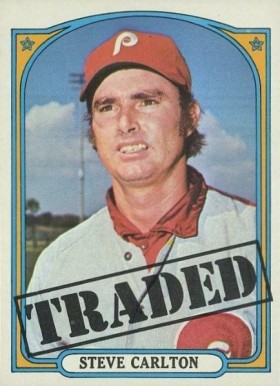
In 1972 he compiled a 7-7 record. His 7 wins was 2nd on the team after Steve Carlton’s 27 wins. (Such was the sad state of the Phillies’ pitching staff that year.)

Darrell was released by the Phillies after the 1973 season. He played for their AAA team in 1974 before retiring.

Fun Fact: Brandon wore #32 for the Phillies in 1971, before switching to #30 with the arrival of Steve Carlton in 1972. Carlton’s number was subsequently retired by the Phillies.

It’s odd that both Baseball-Reference.com and Wikipedia.org refer to him as “Bucky Brandon”. I don’t ever remember seeing his baseball cards without “Darrell” as his name. Although Baseball-Reference will redirect “Darrell Brandon” queries to their Bucky Brandon page, Wikipedia has no knowledge of a “Darrell Brandon”. 

Wednesday, April 6, 2016

Wilbur Wood (#585)

Wilbur Wood pitched for 17 seasons (1961-1978), mostly with the White Sox. I learned today that he originally played for the Red Sox in the early 1960s.

Wood was signed by Boston in 1960, and played in their farm system from 1961-63. He also played a few games with the Sox in ’61 and ’62.

Wilbur began the 1963 season with the Sox’ AAA team in Seattle, but was recalled in early June and pitched in 25 games over the final 2/3 of the season.

Wood opened the ’64 season in Boston, but was sent back to Seattle in mid-May, where he remained until the Pirates purchased his contract in September. He made a few appearances with the Bucs in the season’s final weeks.


1965 was his last season with Pittsburgh. He pitched in 35 games (all but 1 in relief) but only compiled a 1-1 record. After little success in 1965, Wood spent the entire ’66 season with the Pirates’ AAA team, compiling a 14-8 record in 31 games as a starter. For his efforts, he was traded to the White Sox after the season for pitcher Juan Pizarro.

Upon joining the Chisox, their resident knuckleball guru Hoyt Wilhelm convinced Wilbur to throw only the knuckleball, and Wood’s career took off. He was a reliever during his first 4 seasons with Chicago (leading the league in games in ’68, ’69, and ’70, and notching double-digit saves in those 3 years.

Beginning in 1971 he joined the starting rotation. Wood won 20 or more games for 4 straight seasons, and led the AL with 24 wins in both ’72 and ’73. He also pitched more than 300 innings in each of those 4 seasons, topping out at 376 innings in 1972. Wilbur made the All-Star team in 3 of those 4 seasons, and finished in the top 3 in Cy Young voting in ’71 and ’72.

Wood was still a workhorse in 1975 (pitching 291 innings), but slipped to a 16-20 record. He missed much of the 1976 season after a line drive broke one of his knees. Wilbur returned for 2 more seasons, but without his earlier effectiveness. His final game was in August 1978.

Wood was granted free agency after the 1978 season, but had no takers.

Thursday, December 31, 2015

Paul Blair (#135)

Paul Blair was the speedy center fielder for the Orioles during their mid-1960s to mid-1970s golden days.

Blair was signed by the METS (who had yet to field a team) in July 1961. The Orioles claimed him after the 1962 season in the minor-league draft of first-year players. (I learned something new today!) 

Paul played in the Orioles’ system for the ’63 and ’64 seasons, and made his major-league debut in September 1964, playing in 8 games as a pinch-runner or defensive replacement in center field (with only 1 at-bat).


Blair was the Orioles’ starting center fielder for the first 2 months of the 1965 season, then was in and out of the lineup during June, before missing the entire month of July. He returned to the starting lineup on August 6th, and started all the remaining games in center field.

In 1966 Blair played in 133 games, but only had 79 starts (all in center field). Although he only hit .167 in the World Series, he clubbed a home run in the O’s 1-0 win over the Dodgers in game #3.


He was the team’s regular center fielder through the 1976 season, and won 8 Gold Gloves in the 9-year span from 1967 to 1975.

After 1976, he was traded to the Yankees for outfielder Eliot Maddox. After 2 seasons as a part-time player for the outfielder-heavy Yankees, he was released in April 1979.

Blair was signed by the Reds a month later, and was a bench player for the remainder of the season, although he also made 37 starts in center field (but none after early-August).

Granted free agency after the 1979 season, Paul did not find work until the end of May 1980 when the Yankees re-signed him. After appearing in 12 games over the next month, he was released on July 1st, ending his 17-year career.

Blair passed away in December 2013 at age 69.

Monday, May 19, 2014

Al McBean (#514)

Alvin McBean was born and raised in the US Virgin Islands. He was signed by the Pirates in 1958, and pitched in their farm system for 4 seasons (1958-61). He started out as a swingman, but by 1961 he was primarily a reliever.

Al was summoned to the majors in early July, and made his first of 27 appearances for the Bucs on July 2nd. He pitched in relief except for 2 starts in mid-September.

When I was "playing" with my baseball cards back in the day, I always figured McBean to be a 2nd-tier starter behind Bob Veale and Steve Blass, and that the bullpen was headed up by Elroy Face and Pete Mikkelsen. Tonight, I’m finding out that McBean was a key member of the Pirates bullpen from 1963-67, and that my pre-conceived notion of him really only matched his 1968 season. 


In 1962 McBean was plugged into the starting rotation, and compiled a 15-10 record in 33 games, as the #2 starter behind veteran Bob Friend.

In 1963 he was back in the bullpen, and fashioned a 13-3 record along with 11 saves (2nd on the team behind veteran closer Elroy Face).

In ’64 and ’65, Al surpassed Face as the team’s save leader with 22 and 18 saves for those 2 seasons. He was also named Reliever of the Year by The Sporting News in 1964.

After 2 more seasons in the bullpen (behind a rejuvenated Elroy Face), McBean was put back in the starting rotation in 1968. By now, Bob Friend and Vern Law were long gone, with Bob Veale running the show, and Steve Blass at #2. Al was the #3 starter in his final season with the Pirates, compiling a 9-12 record in 36 games (28 starts).

After the season he was selected by the Padres in the expansion draft. After only 1 game with San Diego, McBean was traded to the Dodgers in mid-April for shortstop Tommy Dean.

Al made 31 relief appearances for LA for the remainder of the 1969 season. Al began the 1970 season with the Dodgers, but after only 1 game he was released on April 24th. The Pirates re-signed him on the same day, but after pitching only 10 innings over 7 games (and sporting an ERA of 8.10), he was released on May 18th, ending his major-league career.

I learned tonight that McBean spent the remainder of 1970, and 1971 pitching for the Phillies’ AAA team in Eugene, Oregon.

Tuesday, January 28, 2014

Boog Powell (#381)

John “Boog” Powell was the slugging 1st-sacker for the Orioles in the 1960s and early 1970s. He played for 17 seasons, all but the last 3 for Baltimore. (I didn’t know he also played for the Indians until someone posted his “Cleveland Red Pajamas” card on their blog a year or 2 ago. I also didn’t know he played for the Dodgers until tonight!)

Boog was signed by the Orioles in 1959, and played in the minors from 1959-61, with 2/3 of his games as a 1st baseman and the rest as an outfielder. He made his major-league debut in September 1961, playing 4 games with the O’s.


Powell was inserted into the starting lineup from the get-go in 1962, but with veteran Jim Gentile at 1st base, Boog found a home in left field, starting 112 games there ahead of 1961’s incumbent left fielder, future manager Dick Williams.

In 1964, Powell hit 39 homers (which would be his career-high) and led the AL with a .606 slugging percentage.

Boog continued as the team’s regular left fielder until midway through the 1965 season. Until then, his only significant playing time at 1st base was 23 games in 1963. With rookie outfielder Curt Blefary joining the team in ‘65, Powell began making the occasional start at 1st base in early June, and by the end of the month he had replaced the veteran Norm Siebern at 1st base. His only return to the outfield was for a 2-week stretch in late August (maybe Blefary was on the DL?) It was his last outfield time in his career.

Powell completed his transition to 1st base in 1966. He played 136 games there, clubbed 34 homers, and collected 109 RBI, while finishing 3rd in the MVP voting behind teammates Frank and Brooks Robinson. (Powered by those 3 offensive stars, and their starting pitching, it must have been one big party on the way to a World Series sweep!)

Boog’s numbers declined in ’67 and ’68, but he returned in a big way in 1969 (37/121) and 1970 (35/114). After finishing as the AL MVP runner-up in ’69, he won the award in 1970. The O’s made it to the World Series both years, winning in 1970. Powell was also a 4-time all-star selection from 1968-71.

Boog played for the Orioles through the 1974 season, but never again approached the numbers he put up in ’69 and ’70.

During spring training in 1975, Powell and pitcher Don Hood were traded to the Indians for catcher Dave Duncan. Boog was the tribe’s 1st baseman for all of 1975 and half of 1976. (Cleveland used 10 players at 1st base that season, with Boog starting 83 games there – 60 more than the next guy.)

Cleveland released him near the end of spring training in 1977. A few days later the Dodgers signed him, and used him almost exclusively as a pinch-hitter in his final season. His only start at 1st base came on August 15th. He made 2 more pinch-hitting appearances, then was released on August 31st, ending his 17-year career.

Powell finished with 339 home runs and 1187 RBI.

Saturday, May 14, 2011

Dick Tracewski (#488)

Over the next few posts, I am going to be completing my series on players who retired in the late 1960s (specifically, those players who retired in 1968 or 1969, or whose last card was in 1968).

This post was going to be about 8-year veteran Dick Radatz (who retired in 1969). When I went to my 1968 binder (which is arranged by teams) to retrieve his card, I couldn't find it. Indians? No. Red Sox? No. What the? After consulting my Book of All Topps Knowledge I learned that the veteran Radatz did not have a card in 1968. He was released by the Cubs during spring training in 1968, and spent the entire season with the Tigers' triple-A team, before returning to the majors for one more season in 1969.

I will have to update my list of players without a 1968 card. Meanwhile, on to fellow 8-year-veteran-retiring-in-1969 Dick Tracewski.


Tracewski was signed by the Brooklyn Dodgers in 1953. After 5 seasons in the minors, Dick spent 1958 and 1959 in military service. He returned to another 3 seasons in the minors, and made the Dodgers at the start of the 1963 season.

Tracewski had significant playing time during his first 2 seasons with the Dodgers, backing up Maury Wills at SS in 1963, and sharing 2B with Nate Oliver in 1964. In 1965 he received less playing time than before, primarily as Junior Gilliam's backup at 3rd base. Dick saw action in the 1963 and 1965 World Series with the Dodgers.

After the 1965 season, Dick was traded to the Tigers for relief pitcher Phil Regan. With the Tigers, Tracewski was relegated to 3rd-string middle infielder, especially after the arrival of rookie Tom Matchick in 1968. Still, Tracewski played briefly in his 3rd World Series in 1968. He retired after the 1969 season.

Saturday, January 2, 2010

Giants Rookies?

Well, today my 2 virtual spinners came up "card type = rookies" and "team = Giants", but for some reason Topps didn't issue a Giants Rookies card in 1968. Was it laziness? Short-sightedness? Let's see if Topps even had anyone to pick from that year.


According to Baseball-Reference.com, there were 4 rookies who got some playing time with the 1968 Giants. Even if they were only cups of coffee, they could still qualify under Topps' loose interpretation of "Rookie Stars". (After all, how many times did we see George Lauzerique on a Reds or Athletics "Rookie Stars" card?)

Rich Robertson's stats aren't overly impressive, but they are at least as good as George Korince, the Tigers' farmhand that Topps wasted TWO rookie cards on in 1967:

Some other candidates:


Wait, I think there was one more rookie on the 1968 Giants. Oh yes, it was:

ARE YOU KIDDING ME? Topps couldn't find two players worthy of their "Rookie Stars" interpretation, to slap onto a card in 1968?

Instead, we are treated to a Bobby Etheridge card, with a bright, shiny trophy indicating that he was Topps' selection as the 3rd baseman on the 1967 all-rookie team. In 1967, Etheridge batted a stellar .226 in 40 games, struck out 12 times, and didn't even make the team in 1968!

Sunday, December 27, 2009

Cardinals Team (#497)

In previous seasons, all teams except the Astros had team cards. In 1968, for some reason there were only 13 team cards.

Here is the team card for the World Champion St. Louis Cardinals. Manager Red Schoendienst is front and center, flanked by 2 of his coaches on either side. Curt Flood and Orlando Cepeda (#30) are the 2 players seated on the far left. Steve Carlton (#32) is behind Schoendienst.


The back of the card shows the previous year's leader in several categories. Bob Gibson is absent from these leaders, because he missed 2 months of the 1967 season with a broken leg.

The Cardinals' started the 1967 season with Bob Gibson, Ray Washburn, Larry Jaster, and Al Jackson in the rotation, with Steve Carlton as the #5 starter. In early May, rookie Dick Hughes pushed Jaster out of the rotation. A surprise to me TODAY was that Nelson Briles didn't join the starting rotation until 7/21 (while Gibson was out with a broken leg). When Gibson returned, Briles stayed in the rotation, and both Jaster and Jackson were out.

The Cardinals 1967 World Series rotation was:
1. Gibson (CG)
2. Hughes (others in relief)
3. Briles (CG)
4. Gibson (CG)
5. Carlton (Washburn and others in relief)
6. Hughes (Briles, Washburn, and others in relief)
7. Gibson (CG)