Sunday, February 12, 2012

Final Card: Bruce Von Hoff

This is the only Topps baseball card for Bruce Von Hoff (#530). Like Ron Campbell in 1967 and Dave Watkins in 1970, his major-league career was over before his only card was issued.


Bruce was signed by the Giants in 1964, and pitched in the minors for 7 seasons (1964-70), mostly at the double-A and A levels. He was a starting pitcher in all but his first season. After one season in the Giants' system, Von Hoff pitched for various Astros' clubs for 4 seasons, before moving on to the Reds (1969) and Cardinals (1970).

His only big-league experience came in 1965 (3 relief appearances, 3 innings) and 1967 (10 starts, 50 innings total).

I'm surprised he even has a card in this set, since a) he wasn't one of the Astros' top 12 pitchers in 1967 in terms of games played, and b) this is card #529 (in the last series), so there was plenty of time for Topps to pull this card in favor of someone else more deserving (like a Giants Rookie Stars card!)

Sunday, January 22, 2012

Final Card: Dick Kenworthy

This is the only Topps card for Dick Kenworthy. The back says that he was sent to the Mets in the off-season as the player to be named later in the Ken Boyer trade. Interesting. Baseball-Reference.com makes no mention of Kenworthy ever being sent to the Mets. In fact, it says the White Sox sent J. C. Martin to the Mets on 11/27/67 to complete the trade. Since this is card #63, it must have been printed sometime in late 1967, so maybe Topps was acting on some preliminary scuttlebutt regarding Kenworthy.


Kenworthy was signed by the White Sox in 1961, and played in their minor-league system for 10 seasons, before moving over to the Reds' farm system for 1971 and 1972. He was a 2nd baseman for his first two seasons before switching to 3rd base for the balance of his career.

Dick's major-league experience consisted of a few cups of coffee from 1962 to 1966. Then in 1967 and 1968, he played over 50 games each season with the White Sox, about half of them as the starting 3rd baseman.

Since he played for the White Sox in both '67 and '68, it looks like Baseball-Reference.com is right and Topps was wrong. Maybe a White Sox fan can clarify this.

Tuesday, January 17, 2012

Final Card: Dick Lines

The 1960s' Hall of Fame results are now on my 1960s Baseball blog.


This is the 2nd and last Topps card for Senators' pitcher Dick Lines (#291). His rookie card was in the 1967 set, a 1-player card showing Lines with the Senators.

Lines' career is somewhat of a mystery. He spent 9 full seasons in the minors, before pitching the entire 1966 and 1967 seasons with the Senators. Then, it was back to the minors for 2 more seasons before calling it quits.


Lines was signed by the Pirates in 1957, and pitched in their farm system for 8 seasons, all but the last as a starting pitcher. Prior to the 1965 season, his contract was sold to the Senators. That season he pitched for the Sens' AAA team in Hawaii, which finally earned him a shot in the majors.

Dick spent the entire 1966 season as the only lefthander in Washington's bullpen, which featured veterans Ron Kline and Bob Humphreys, along with Casey Cox and 3 others who floated between the bullpen and the rotation (Jim Hannan, Diego Segui, and Dick Bosman). Lines fashioned a 5-2 record in 82 innings, and had a 49/24 strikeout-to-walk ratio.

In 1967, the Senators' bullpen featured Darold Knowles (a lefty), veteran Bob Priddy, and rookie Dave Baldwin in place of Ron Kline and Diego Segui. Lines, Humphreys, and Cox were the holdovers from '66. Knowles and Baldwin were the stars in terms of saves and ERA, and Knowles, Humphreys, and Priddy had the most innings pitched among relievers. Lines had similar games, innings, and strikeout/walks to the previous season, but his record fell from 5-2 to 2-5. I guess he was just out-performed by the other guys, because he didn't pitch in the majors after 1967.

Two more seasons (1968-69) in the Nats' farm system brought an end to Dick Lines' career.

Friday, January 13, 2012

Final Card: Garry Roggenburk

This is the final card for Garry Roggenburk (#581). Garry was signed by the Twins in 1962 and was assigned to the class-D Erie (PA) Sailors, where his teammates included future big-leaguers Jim Merritt, Joe Foy, and Ted Uhlaender. He started all 18 of his appearances that season, fashioning a 13-4 record. After only 1 season in the minors, he made the Twins in 1963, debuting on April 20th. With the Twins, he mainly worked out of the bullpen, only starting 2 of his 36 games.

Garry missed the entire 1964 season with injuries. When he returned, he split each of the next 2 years between Minnesota and their triple-A Denver team. During those seasons, he was a relief pitcher except for his minor-league stint in 1966.


In early September 1966, Garry's contract was sold to the Red Sox. Although he had a card in the 1967 Topps set, he spent the entire season in the minors, missing Boston's trip to the World Series.

The 1968 and 1969 seasons were a repeat of 1965 and 1966, only the cities changed. Roggenburk spent part of each season with the Red Sox and part in the minors. The only change of pace was that in June 1969 he was sold to the expansion Seattle Pilots. He pitched 24 innings over the final half of that season for the Pilots, both as a starter and reliever.

Sunday, January 1, 2012

Orioles Rookies - Frank Peters / Ron Stone

This is the 2nd of three Orioles Rookies cards in the 1968 set (#409). Topps also included three Orioles Rookies cards in the 1966 and 1967 set, whereas most teams got only one or two rookies cards. If you were an Orioles fan in the mid-1960s, you really got your money's worth, what with all the rookie cards, World Series highlights in 1967, league leaders cards (thanks to Frank Robinson and Dave McNally), and various multi-player cards.

Frank Peters spent 10 seasons in the minor leagues from 1964-74 (mostly in the Orioles' chain) and never played in the big leagues. Topps' comment on the back about Luis Aparicio's departure paving the way for Peters left out one small detail: Mark Belanger.


Ron Stone takes his place alongside Lou Piniella as a frequent guest on Topps' rookie cards in the 1960s. Stone was in the 1966 set with the Athletics, here with the Orioles, and in 1969 with the Phillies, before getting his own Phillies' cards in '70, '71, and '72.

Signed by the Orioles in 1963, Stone spent 1963-1968 in Baltimore's farm system, except for a Rule 5 cup of coffee with the Athletics in early 1966. On 7/1/66, he was returned to the Orioles, where he languished until Baltimore traded him to the Phillies for catcher Clay Dalrymple in January 1969.

The highlight of his career was spring training 1969, where he assumed the role of spring phenom. Once the season began, he settled into a spare outfielder role through the end of the 1972 season. He retired after spending all of 1973 with the triple-A Phillies and Royals.

Tuesday, December 27, 2011

Final card: Jerry Buchek

Here is the final card for Mets' 2nd baseman Jerry Buchek (#277). This was the first of three Buchek cards I acquired. Jerry's 1967 card is in the high-numbered 7th series, so I didn't get that until years later.

By the time I jumped on the major-league baseball bandwagon in May 1967, Buchek was the Mets' regular 2nd baseman. I didn't realize until checking his stats for this column that he only became a Met on April 1st that year, about a week before the start of the season. His 1967 card shows him in full Mets' gear, which is an amazing and unexpected feat by the Topps photography department, given their record of lagging behind the curve with updated photos for the 1967-68-69 Don Lock, 1968-69 Woody Fryman, 1968-69 Turk Farrell, 1968 Tommie Aaron, etc, etc, etc.


Buchek was signed by the Cardinals in 1959, and played 4 seasons (1960-63) in their farm system as a shortstop, making brief appearances with St. Louis in 1961 and 1963.

He made the Cardinals for good at the start of the 1964 season, playing in 35 games as a SS-2B backup, as well as a few appearances in the World Series. During the 1965-66 seasons, although still a backup, he began playing much more at 2nd base than in previous seasons.

A week before the 1967 season, Jerry was traded to the Mets (along with pitcher Art Mahaffey) for veteran shortstop Ed Bressoud and outfielder Dan Napolean. Buchek alternated with veteran Chuck Hiller at 2B during April, then started almost every game at 2B during May, June, and July. For the remainder of the season, he alternated between 2nd, 3rd, shortstop, and the bench. In 411 at-bats, he only managed to hit .236, which probably hastened the end of his career.

The emergence of rookie 2nd baseman Ken Boswell severely limited Buchek's playing time in 1968. He was primarily relegated to the bench, although he made a few dozen starts at 3rd base spelling veteran Ed Charles. After the season, Jerry was traded back to the Cardinals, for minor-league pitcher Jim Cosman.

Before the start of the 1969 season, he was flipped to the Phillies in exchange for 1st baseman Bill White. Buchek spent the year with the Phillies' triple-A team in Eugene, Oregon before retiring.

Friday, November 18, 2011

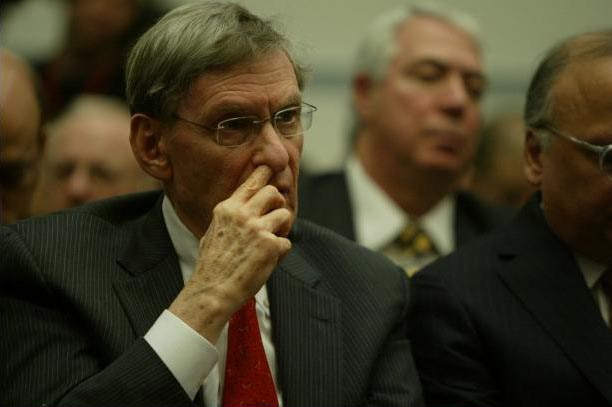
The Genius that is Bud Selig

Ok, we're going to vote on who moves to the American League. Are there any suggestions?

What?

What? I can't hear you.

What? You'll have to talk over the noise.

Criminy, I just can't hear anyone over the loud protesting by those damn fans. Can't they see I'm busy?

Ok, here's what we will do. Raise ONE finger to vote for the Astros...

and TWO fingers to vote for the Brewers.

Saturday, September 24, 2011

Back on Topps' Radar: John Boozer

John Boozer (#173) returns to the Topps set after missing out in 1967. John had a baseball card every year from 1963-69, except in the 1967 set. How ironic, since that was his only winning season (5-4).

Boozer was signed by the Phillies in 1958, and spent his entire career in the Phillies' organization. Except for the 1968 season, he pitched in the minors every season from 1958 to 1969, primarily as a starting pitcher.

John made his major-league debut in July 1962. He was primarily a long reliever for Philadelphia, but also made some spot starts. Most of his time in the bigs came from 1963-64, and 1967-69.


I remember that in 1967, he was recalled around Memorial Day, after the Phillies cleaned house of several veteran relievers. After the 1966 season, the Phillies went on a binge, signing aging veterans Dick Hall, Pedro Ramos, and Ruben Gomez to shore up their bullpen. Only Hall panned out, and the other 2 (along with holdover Bob Buhl) were all given an early-season boot.

The Phillies' revamped bullpen that season included Turk Farrell (acquired in May) and Hall as the 2 firemen, along with rookie Grant Jackson (a lefty) and the recently-recalled Boozer. They also reclaimed Dallas Green off the scrap heap, who didn't do too much in his final season except collect days toward his pension.

Anyhoo, Boozer was the right-handed long man and occasional spot starter. Somehow, he managed to stay with the big club for the entire 1968 season. I don't know if it was his performance, as much as it was the Phillies not having many other options. After all, it would be another year or so until their "phenoms" (Lowell "Shades" Palmer, Billy Champion, Barry Lersch, and Billy Wilson) were ready.