Wednesday, December 28, 2016

Bobby Knoop (#271)

Here is Angels’ 2nd baseman Bobby Knoop, at 78 the oldest living player from 1966-70 that I haven’t blogged about yet. (Back in the Sixties, my brother and I thought his name was pronounced NEWP, but it is Kuh-NOP.)

Knoop was signed by the Milwaukee Braves in 1956, and after 8 long years in the minors, the Angels acquired him in the Rule 5 draft after the 1963 season. (Hmm… the record shows he played for the Angels’ AAA team in Hawaii in ’62 and ’63. Maybe he was on loan, and the Angels liked him so much that they acquired him outright.) 

Like all other Rule 5 picks, he needed to stay on the major-league roster the following year. Unlike so many, he was a real contributor, playing in all 162 games (starting 156) as a rookie in 1964.


Bobby was a mainstay during his 5 full seasons with the Angels. He played in 162, 162, 161, 159, and 152 games over that span, always accumulating more than 500 plate appearances. In 1966 he made his only All-Star team, and led the AL with 11 triples. However, he hit higher than .249 only once.

After starting 23 of the first 24 games in 1969, he was traded in mid-May to the White Sox for 2nd baseman Sandy Alomar and pitcher Bob Priddy. Knoop started 100 and 117 games in his 2 seasons with Chicago.

With the Sox having acquired 2nd baseman Mike Andrews from Boston in December 1970, Knoop was traded to the Royals during spring training 1971 for infielder Luis Alcaraz.

Bobby was the backup infielder for KC in 1971, but started 41 games at 2nd base, mostly after Cookie Rojas was lost for the season in late-August. In 1972 he only started 22 times, his final game coming on September 20th.

 He was released after the 1972 season, ending his 9-year career.

 He was a coach for the White Sox, Angels, and Blue Jays for 21 seasons (1977-2000).

Wednesday, December 14, 2016

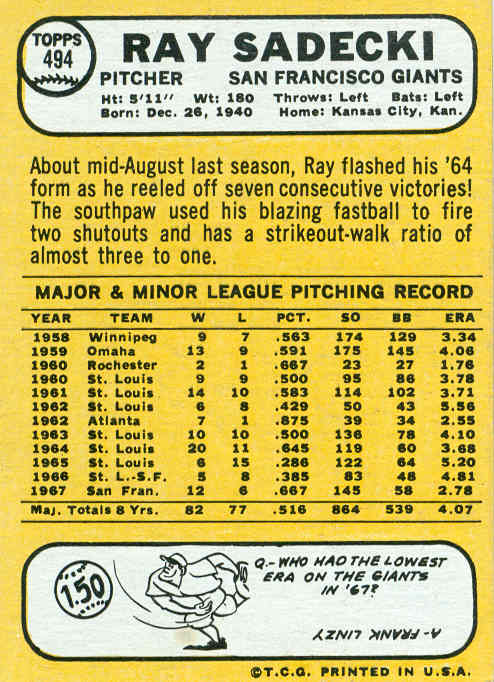
Ray Sadecki (#494)

Ray Sadecki was a starting pitcher for the Cardinals and Giants in the 1960s. He later played for the Mets and several other teams.

Ray was signed by the Cardinals in 1958 and made his big-league debut with St. Louis in May 1960. At age 19, he was the team’s #3 starter behind Larry Jackson and Ernie Broglio.

In 1961 he led the staff in starts and innings pitched, shared the wins lead with Jackson, and was 2nd in strikeouts to Bob Gibson.

1962 was a down year. By the end of July Ray’s record was 6-8, and he was sent to the minors for the remainder of the season.


Ray was back in 1963, joining Gibson (18 wins), Broglio (18), and a rejuvenated Curt Simmons (14) in the rotation. (Jackson had been traded to the Cubs in the off-season.) He compiled a 10-10 record as the #4 starter.

1964 ended with the Cardinals winning the World Series. Along the way Sadecki won 20 games, just slightly ahead of Gibby’s 19 and Simmons’ 18 wins.

In 1965 the Cards’ rotation was reduced from the “Big 3” to the “Big 1” (Gibson), as both Sadecki and Simmons lost 15 games. The following May, Sadecki was traded to the Giants for slugger Orlando Cepeda.

Over the next 3 ½ seasons, Ray manned the #4 spot in the rotation, behind Juan Marichal, Gaylord Perry, and Bob Bolin (and later Mike McCormick). He was 32-39 in his time with the Giants, never matching his success with the Cardinals, but he did win 12 games twice and piled up a lot of innings for the Giants.

Ray was traded to the Mets after the 1969 season with outfield prospect Dave Marshall for journeyman outfielder Jim Gosger and utility infielder Bob Heise. [WOW! What a sad state of affairs!] 

After 5 uneventful season with the Mets (used as a starter and reliever), he was traded back to the Cardinals for Joe Torre. After 2 months with St Louis, he was flipped to the Braves, and by Labor Day he was with the Royals.

Sadecki pitched 5 games for Kansas City at the end of 1975, and 3 games at the start of 1976 before he was released in early May. The Brewers soon picked him up, and he relieved in 36 games for the remainder of the ’76 season. Released again, Ray was signed by the Mets in March 1977 but was released on May 2nd, ending his 18-year career.

Sadecki passed away from cancer in November 2014 at age 73.

Wednesday, December 7, 2016

Born on the Same Day - 5/11/1939

Another installment in my "Born on the Same Day" series, featuring players who were born on the same day (!) and year.

This is post #11 in the series: Milt Pappas and Frank Quilici - both born on 5/11/1939.


Pappas played 17 seasons, the first 9 with the Orioles. Traded to the Reds after the 1965 season for Frank Robinson, he played 2 1/2 seasons with Cincinnati, 2 with the Braves, and 3 1/2 with the Cubs before retiring after the 1973 season. He made the All-Star team in '62 and '65.

Quilici was a backup 2nd baseman for the Twins from 1965 to 1970, playing in the post-season in his first and last seasons. He also managed the Twins from 1972 to 1975.

Saturday, November 19, 2016

Mike Epstein (#358)

Mike Epstein was a slugging 1st-sacker for the Senators in the late-1960s. This is his first solo card, after appearing on an Orioles Rookies card in the 1967 set.

Prior to being signed by the Orioles in 1964, Epstein was a member of the US Olympic baseball team that won the gold medal that year.


Missing from the back of his card is his time playing for the Orioles’ Florida State Instructional League (rookie ball) team for 3 seasons from 1964-66. He played most of 1965 in class A ball and most of 1966 in AAA ball, and clubbed 30 and 29 homers respectively, along with topping 100 RBI in both seasons.

He made his major-league debut in September 1966, but realizing he was stuck behind Boog Powell at first base, he demanded a trade. After cooling his heels on the O’s bench for 2 months of 1967, he was traded to the Senators in late-May (along with pitcher Frank Bertaina) for pitcher Pete Richert. In his first at-bat against his old team, Epstein hit a grand slam.

Mike was the Nats’ regular 1st baseman for 3 seasons, starting 107, 115, and 118 games from 1968-70. (Left fielder Frank Howard started most of the remaining games at 1B.) however, his numbers were down from his minor-league stats. His best season was 1969 – reaching 30 HR and 85 RBI.

In May 1971, he and pitcher Darold Knowles were shipped to the Athletics for pitcher Paul Linblad, 1st baseman Don Mincher, and backup catcher Frank Fernandez.

Following the 1972 season, he moved on to the Texas Rangers, but after only 27 games with Texas, he was flipped to the Angels in a 5-player deal. He was the Angels’ 1st baseman for the remainder of the ’73 season.

Epstein started 18 of the first 21 games in 1974, but he and his .161 batting average were released when the calendar hit May.

Friday, October 28, 2016

Born on the Same Day - 1/17/1915

Today I'm starting a new series called "Born on the Same Day", featuring players who were born on the same day (!) and year. The scope of this exercise is those players (or managers) who have cards in the 1965-1970 sets (because that's what I dooze). Ideally, I should also have their cards.

In researching this, I found 51 pairs and 2 trios. In a few pairs both are stars, some pairs have 1 star, and other pairs are just 2 guys named Joe. In a few cases, these players were also teammates. 

I am going to post these in chronological order, and distribute them across my 1966-1970 blogs depending on which cards I have for who. 


So with chronology in mind, first up is the only pair of managers: Mayo Smith and Luman Harris, both born on 1/17/1915.


Lum Harris played for the Philadelphia Athletics from 1941 to 1946, except for the 1945 season while he was in military service. Coincidentally, Mayo Smith's only MLB season was in 1945... for the Athletics. So they missed each other by a year.

Sunday, October 23, 2016

Rich Rollins (#243)

This is Rich Rollins’ final card as a Twin. After the 1968 season he joined the expansion Seattle Pilots.

Rollins was signed by the old Washington Senators in 1960. Midway through the 1961 season, he made his major-league debut for the team, in their first season as the Minnesota Twins.


In 1962, Rich hit .298, collected 96 RBI, and made his only All-Star team, as he started 158 of the team’s 163 games at the hot corner (every game except the 5 from 9/13 to 9/18).

The Twins had some iron-men that season: 
Bernie Allen – 158 starts at 2B 
Rich Rollins – 158 starts at 3B 
Zoilo Versalles – 157 starts at SS 
Harmon Killebrew – 150 starts in LF, 2 at 1B 
Lenny Green – 147 starts in CF, 4 in LF 
Earl Battey – 143 starts at C 
Vic Power – 141 starts at 1B 
Bob Allison – 139 starts in RF 

Rich was the Twins’ everyday 3rd-sacker for the next 2 years, starting 132 and 146 games there. In 1964 he led the AL with 10 triples.

In 1965 his starts were down to 110 (plus 12 starts at 2nd base). The decrease was due to Killebrew having moved in from left field beginning in 1965. Although Killer primarily played 1st base, he started 40 games at 3rd in an effort to keep Don Mincher’s bat in the lineup. Rollins’ days as an every-day player ended after 1965.

Killebrew started 103 games at 3B, to Rollins’ 59 games in 1966. Still, Rich appeared in another 30 games as a pinch-hitter and defensive replacement.

With Mincher shipped off to the Angels after the 1966 season in exchange for Dean Chance, Killebrew took up full-time residence at 1st base. Rollins benefited with 90 starts at 3rd base, while jack-of-all-trades Cesar Tovar started 56 games there.

Rollins’ final season in Minnesota (1968) saw him relegated to the bench for all but 44 games, as Tovar became the primary 3rd baseman, and utility types like Frank Quilici and Ron Clark also getting some playing time.

After the ’68 season, Rich was selected by the Pilots, and began the season as the starting 3rd baseman. He started 39 of the first 62 games there, then took a seat on the bench for the rest of the season. The team used a fleet of utility players there (Gus Gil, John Kennedy, Ron Clark) before settling on Tommy Harper for the final 2 months of the season.

After playing only 14 games with the Brewers, Rollins was released in mid-May 1970. He was picked up on the same day by the Indians, and played 42 games (all but 4 as a pinch-hitter) over the remainder of his final season.

He played in 1002 games over his 10-year career.

Sunday, September 25, 2016

1968 Custom Cards

A few years ago, John Hogan at the "Cards That Never Were" blog made a batch of custom baseball and football cards for me at my request.  I noticed that John did not include these images on his own blog, so I am posting them here so they can be appreciated by all. These are cards where the player was either missing, traded during the season, or just to upgrade a player from a Rookie Stars card to a solo card.

You may have already seen the 1967, 1968, and 1971 football cards or the 1966 and 1967 baseball cards he made for me on the blogs for those sets. He also created some baseball cards in the '68 and '69 style.


Key rookies without cards:

Del Unser made his major-league debut at the start of the 1968 season, winning the starting center field job. He was selected to the Topps All-Rookie team.


Sparky Lyle joined the Red Sox in July 1967 and was with the team for the remainder of the season, yet he did not have a card until 1969.


Bobby Cox' MLB playing career lasted 2 seasons. He was the Yankees' 3rd baseman as a rookie in 1968, and shared the job in 1969. He went on to a long career as the Braves' manager.


Hector Torres debuted in 1968 as the Astros' starting shortstop, his only season as a regular. He played for several teams over the next 9 seasons.

Clyde Wright was one of several young pitchers on the Angels' staff in 1968 (along with Rickey Clark, Tom Burgmeier, and Marty Pattin) who did not have cards in the 1968 set (or in previous years).


Marty Pattin and Tom Burgmeier both made their MLB debut in 1968, with significant playing time. They were both selected by expansion teams after the season.

---------------------------------------------------------------------------

Although not requested by me, here are some other 1968 creations John has featured on his blog:

Earl Weaver took over the Orioles' managerial post in mid-July 1968 after Hank Bauer was fired.


The White Sox' shortstop from 1930-1950, Luke Appling filled in as interim manager for the Athletics' last 40 games of the 1967 season. He did not return in 1968.


Satchel Paige pitched in the Negro Leagues from 1927-47, then pitched 52 games for the Indians (1948-49) and 126 games for the St. Louis Browns (1951-53). He also pitched 1 game for the Athletics in 1965 (at age 58). I have a recollection that he also pitched for the Braves in '67 or '68, but the record does not confirm that. 


Bill Virdon was the Pirates' center fielder from 1956-65. After retiring, he became a coach for the Pirates, and was reactivated for 6 games during the 1968 season.


Lenny Green played for several teams from 1959-66, and finished up his career with the Tigers in 1967 and 1968. He began both of those seasons in the minors, affecting his inclusion in those 2 sets.
 

Alan Foster pitched a few games for the Dodgers in '67 and '68, then pitched for the Dodgers and others from 1969-76.

Sunday, August 14, 2016

Max Alvis (#340)

Max Alvis was the Indians’ regular 3rd baseman from 1963 to 1968, then shared the job with utilityman Lou Klimchock in 1969.

I was going to start off this post saying "With the steep decline in Leon Wagner’s and Rocky Colavito’s home run totals in 1967, Alvis became the lead slugger for the Tribe." Today I see that this was only for 1967, as the next year Max also caught the disease. After averaging 20 homers per season from ‘63 to ‘67, he hit only 8 in 1968, and 1 in limited duty in 1969.


Alvis was signed by Cleveland in 1958, and made his major-league debut in September 1962 by starting 12 of the final 16 games at third base.

Max was installed as the team’s regular 3rd baseman at the start of 1963, replacing the veteran Bubba Phillips. Max started 158 games as a rookie and hit 22 homers.

He was a steady performer for his first 5 full seasons, hitting between 17 and 22 home runs, and made 2 All-Star teams during that time. He missed 6 weeks in 1964 with spinal meningitis, but still hit 18 homers in only 380 at-bats.

He returned to full-time status in 1965, and played 155+ games in each of the next 3 seasons. As mentioned at the top, he lead the Indians in 1967 with 21 homers, and made his 2nd All-Star team.

In 1968, Alvis’ homers (8) and batting average (.223) fell off drastically, and was out of the starting lineup for much of July. Max only started 51 games in 1969 (mostly in May and June), as the team used Klimchock and several others to fill in.

Three days before the 1970 season, Alvis and outfielder Russ Snyder were traded to the Brewers for 2nd baseman Frank Coggins and outfielder Roy Foster. Alvis started 16 of the first 18 games at the hot corner, but was then replaced by Tommy Harper and only saw spot duty for the rest of the season. He was released after the season.